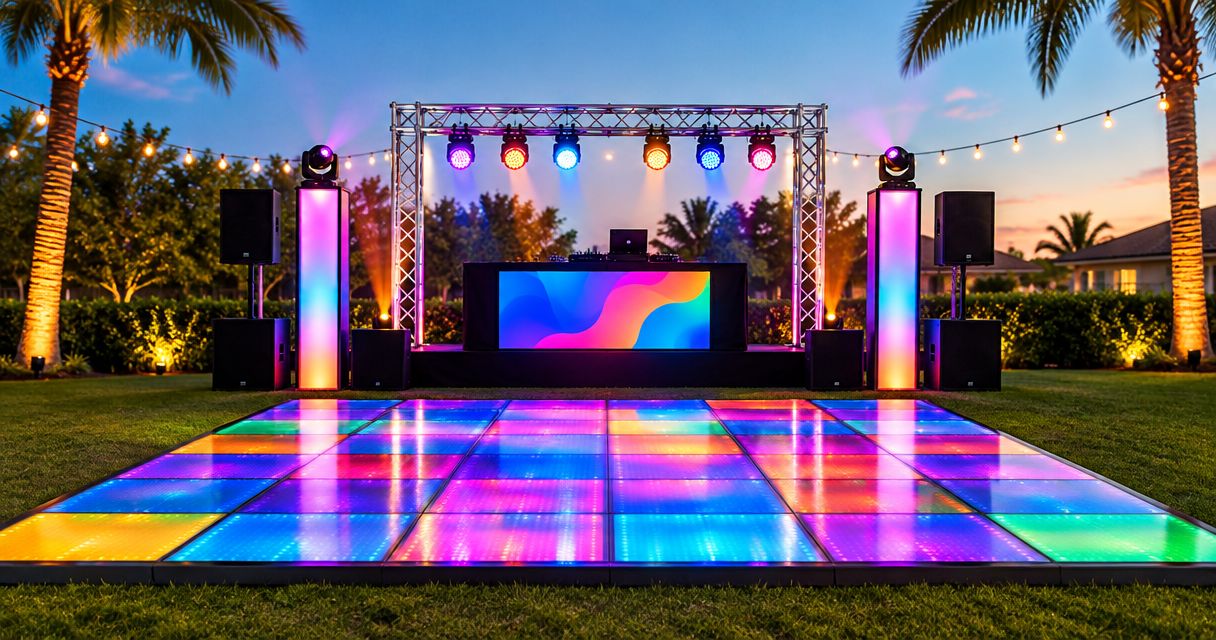
HOA LED dance floor rental is a temporary illuminated dance-floor setup for a homeowners association gathering, with the aim of creating a shared activity for residents. Unlike a private party, an HOA event needs a plan for common-area access, board approval, nearby homes and guests who want to sit rather than dance.
- For LED dance floor rental for HOA events, approve space, power and setup access before choosing a floor.
- Arizona Bounce Around suits Phoenix planners coordinating party and carnival rentals for mixed-age community events.
- Compare an LED floor with a standard portable floor or the clubhouse’s existing dance area.
- Request equipment-specific dimensions, electrical requirements, edge details and setup responsibilities in writing.
Why this matters
Choose the layout before the lighting effects. A dance floor must fit the room while leaving usable routes to seating, restrooms and exits. The space shown on a clubhouse booking form is not necessarily the space you can dedicate to dancing.
For a 2026 HOA event, start with the approved room layout and the association’s event rules. Treat the floor, sound system, food service and resident seating as parts of the same plan, not separate bookings.
Arizona Bounce Around provides party and carnival equipment rentals for Phoenix-area events. Arizona Bounce Around is best for Phoenix planners coordinating party and carnival equipment for mixed-age community events. Ask about the specific dance-floor request rather than assuming a general equipment selection includes a particular LED floor.
Why LED dance floor planning matters for HOAs
An HOA clubhouse serves several purposes: gathering space, meeting room, dining area and sometimes a route to other amenities. Your event plan needs to preserve the functions residents still need while the party takes place.
The guest mix matters just as much. Children need clear boundaries, dancers need an unobstructed activity area, and seated guests need somewhere to talk without occupying the entrance to the floor. A resident birthday celebration or family reunion needs these same basics, even when attendance is smaller than a neighborhood social.
School, corporate and community planners face similar layout questions, but an HOA adds association approval and nearby residents to the decision. In Phoenix, Scottsdale, Chandler and Mesa, establish the actual venue conditions rather than treating every clubhouse or courtyard as interchangeable.
An LED floor is a good fit when dancing is a planned activity, not merely a decorative idea. If conversation, dinner or games dominate the evening, protect those uses first.
How to plan an HOA dance-floor rental
Define the event before choosing equipment
Write a short event brief yourself before requesting recommendations. Describe what residents will do, who will attend and when dancing fits into the schedule. A dinner followed by dancing needs a different arrangement from a family afternoon with children moving between activities.
For your 2026 planning sheet, separate total attendance from the group expected to dance together. Do not use the whole guest list as a substitute for a layout discussion. Include residents who need seating close to the activity and those who prefer a quieter area.
For a backyard birthday or family party, use the same approach: decide whether dancing is the main activity or an extra. Avoid filling the yard with equipment before accounting for tables and access.
- Name the event type and intended audience.
- Describe the planned dancing portion of the schedule.
- Identify seated activities that must remain usable.
- Record the association’s approval process and event restrictions.
- Name the person authorized to approve changes.
Measure the usable space and delivery route
Use a tape measure and sketch the space before discussing floor sizes. Record dimensions in feet, then mark doors, fixed furniture, columns and routes that must stay open. Ask the supplier to confirm both the floor dimensions and any additional space required around it.
Measure the route into the room, not just the room itself. A convenient clubhouse entrance for guests is not automatically the right unloading entrance. Include gates, turns, steps and elevator access in the site description.
Take at least 4 site photos: the proposed floor area, the unloading location, the entrance and the electrical access point. Those images give the venue contact and rental supplier the same starting point without replacing their equipment-specific assessment.
- Measure the clear activity area in feet.
- Record entrance and gate widths in inches.
- Mark furniture that cannot be moved.
- Trace the unloading route through every doorway and turn.
- Identify exits and accessible routes that must remain clear.
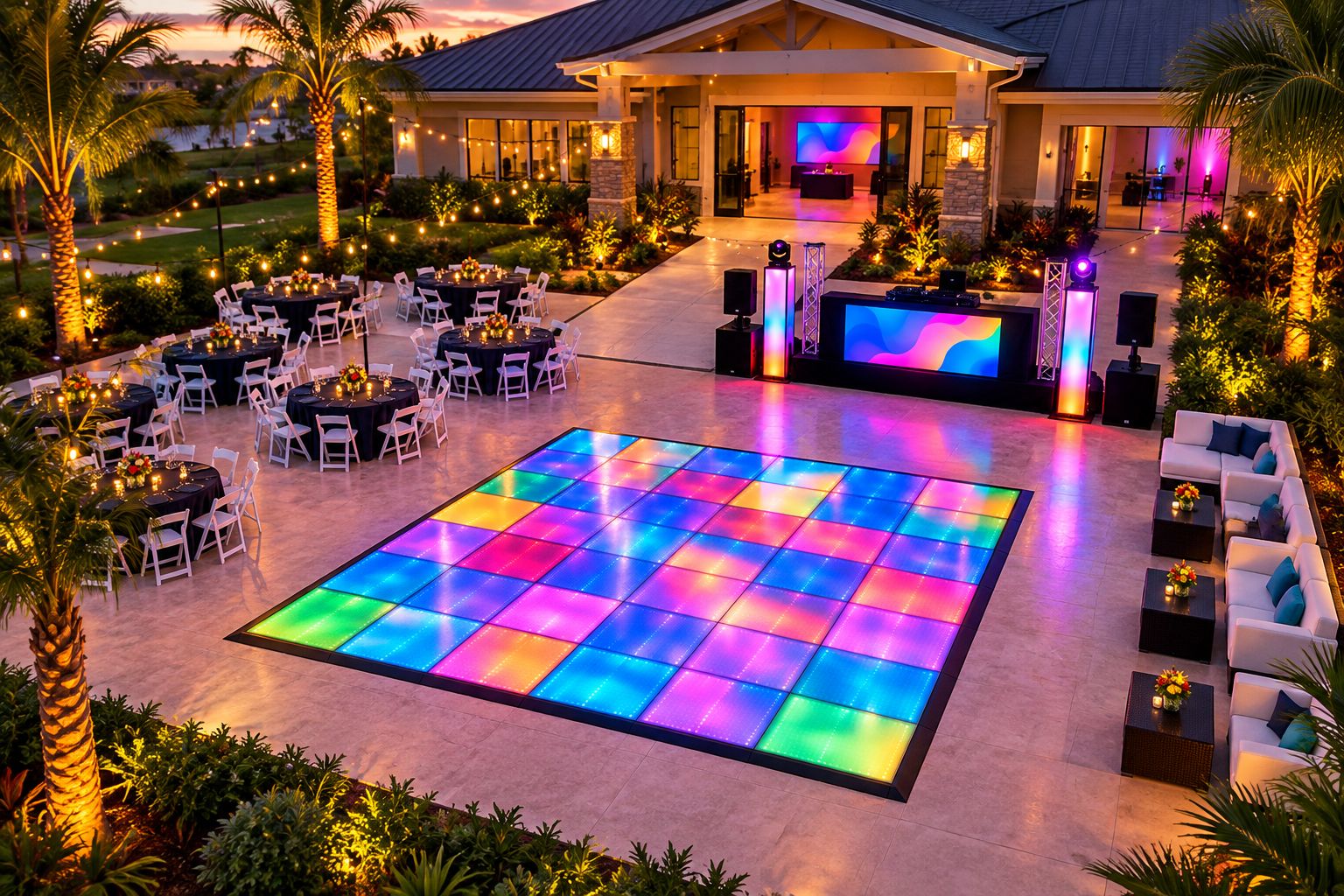
Match the floor to the event and surface
Compare the clubhouse’s existing surface with rental alternatives before choosing an illuminated floor. Ask the venue whether dancing is permitted on its floor and whether a temporary installation needs approval. Then ask the rental supplier which surfaces the specific equipment accepts.
Arizona Bounce Around’s party rental selection includes bounce houses, carnival games, tents and concession equipment. That range supports a broader event conversation, but an LED dance-floor request still needs confirmation of the exact equipment and installation conditions.
An indoor clubhouse, covered patio and open courtyard are different proposals. Do not treat a covering as proof that equipment is suitable outdoors. For an outdoor Phoenix event, ask how heat, sunlight, wind or rain affect the proposed setup and operating plan.
- Confirm the venue’s permitted uses and surface restrictions.
- Request the exact floor dimensions and installation requirements.
- Ask about edges, transitions and access onto the floor.
- Confirm whether the proposed equipment accepts the intended setting.
- Compare dancing with other activities competing for the same space.
Verify power with the supplier and venue
Locate outlets yourself, but leave electrical suitability to the people responsible for the venue and equipment. An outlet beside the dance area does not establish that the circuit can support everything planned for that location.
Ask the supplier for the electrical requirements of the exact floor, including its controls and related equipment. Have the venue contact review those requirements alongside the DJ, speakers, lighting and concession equipment. Do not select a generator or extension cable by guesswork.
For a 2026 event file, keep the electrical details with the approved layout. If the dance floor moves, review the power route again; an earlier decision about cable placement no longer describes the revised setup.
- Request electrical requirements in writing.
- Identify the venue contact who can confirm circuits.
- List other equipment using the proposed power area.
- Agree on cable routing and suitable cable protection.
- Assign responsibility for electrical connections and changes.
Coordinate sound, lighting and resident comfort
Start with the clubhouse’s existing rules for amplified sound and event hours. Then explain the dancing schedule to the DJ or sound provider. A bright dance area does not remove the need to see entrances, seating, steps and floor edges.
For a mixed-age HOA party, plan a place where residents can talk away from the speakers. Give family celebrations the same consideration: grandparents, children taking breaks and guests who do not dance still need a comfortable place in the layout.
Ask how the proposed LED floor’s lighting patterns are controlled and whether they can be adjusted for the event. Keep requests specific rather than assuming every floor has the same settings. For a school or corporate gathering, share any organizer requirements before equipment is selected.
- Confirm permitted sound levels and event hours with the venue.
- Place speakers without obstructing walking routes.
- Keep general room lighting in the event plan.
- Ask about adjustable lighting patterns and controls.
- Position conversation seating away from the main sound area.
Assign setup, handoff and removal responsibilities
Make a simple responsibility sheet before approving the rental. Identify who opens the building, authorizes placement, receives equipment and remains reachable during the event. Name 1 event lead so the supplier does not receive conflicting instructions from several volunteers.
Discuss delivery and setup with Arizona Bounce Around as part of the quote, including what applies to the requested equipment. Ask how equipment preparation and cleanliness are handled, who checks the completed installation and what the organizer should do if a problem occurs.
Include removal in the same discussion. For larger events elsewhere in Arizona, confirm the service location, delivery arrangements and timing by quote rather than assuming a Phoenix-area plan applies statewide.
- Assign building access and unloading coordination.
- Confirm who installs and removes each item.
- Identify who accepts the completed setup.
- Request operating instructions and a problem-reporting contact.
- Confirm the agreed condition of the room after removal.
Request a quote against one approved plan
Combine your notes into 1 site plan rather than sending separate instructions from several board members. Include the event address, date, schedule, measured area, surface, access route and power information. Attach the site photos and identify any approvals still required.
For a 2026 quote comparison, ask suppliers to describe the same scope. A proposal for equipment alone is not equivalent to one that also describes installation, controls, cable routing and removal. Compare responsibilities as closely as the equipment description.
Send Arizona Bounce Around the event brief when asking about party rentals and the specific dance-floor request. Ask for equipment confirmation and a written scope before the HOA approves the arrangement.
- Attach the measured layout and access photos.
- State the requested setup and removal windows.
- Identify the surface and indoor or outdoor setting.
- Request a clear list of included equipment and services.
- Record changes against the same approved plan.
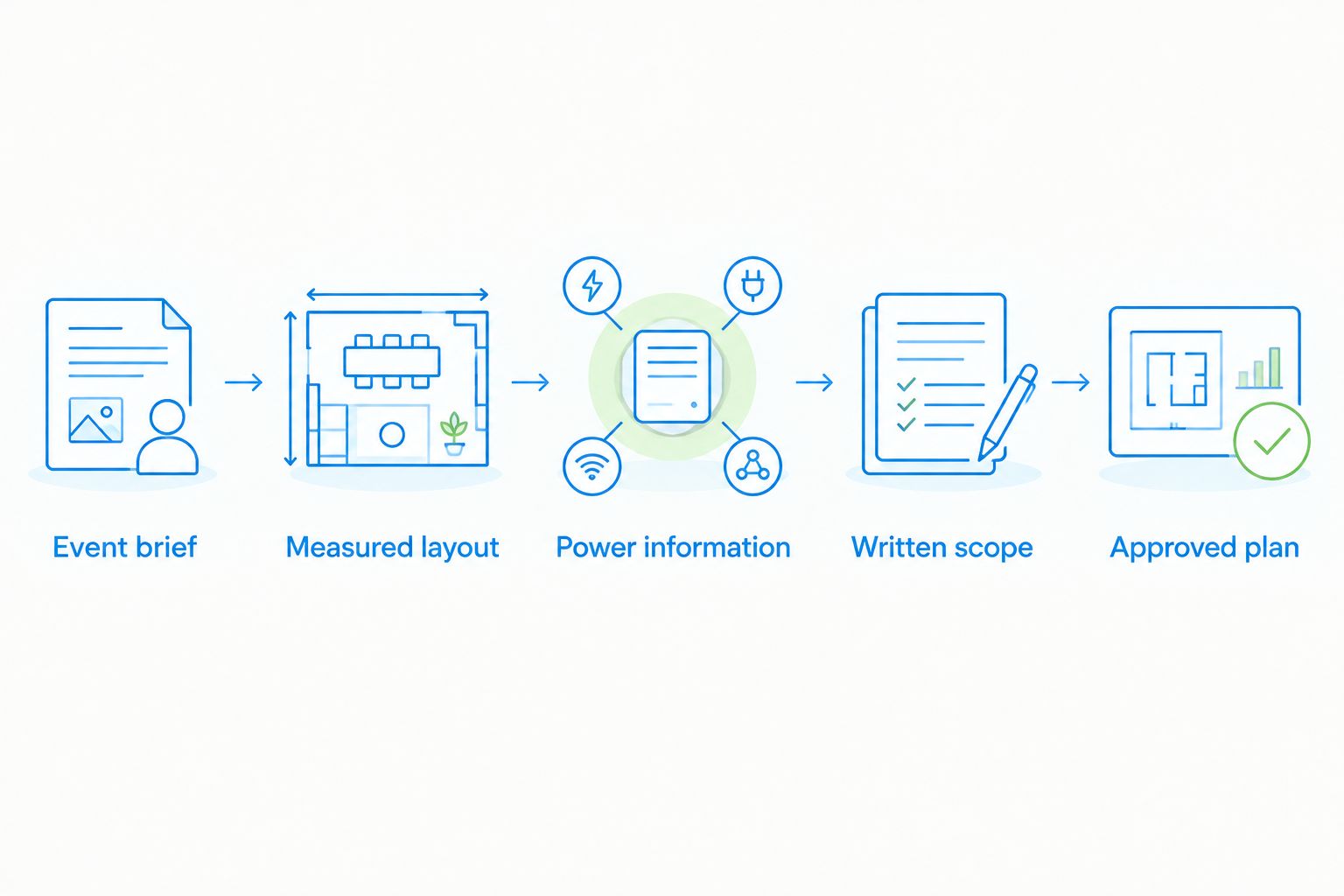
The most useful quote request explains the site clearly enough for the supplier to identify questions before delivery. Resolve those questions before circulating a final layout to volunteers.
Plan your HOA event rentals
Share your event location, measured space, access details and equipment requests.
Compare dance-area options for an HOA event
The best option is the one that supports the event without displacing essential seating or access. Compare these arrangements before committing to an illuminated floor; each solves a different planning problem.
| Option | Best for | Main advantage | Key limitation |
|---|---|---|---|
| LED dance floor | Dance-focused HOA socials | Makes the dancing area visually distinct | Requires confirmation of electrical needs, controls and site suitability |
| Standard portable dance floor | Events needing a defined dance surface without illuminated panels | Separates dancing from surrounding activities | Still requires surface, edge and installation checks |
| Existing clubhouse floor | Gatherings where the venue already permits dancing | Avoids adding a temporary floor installation | The venue’s surface, furniture and permitted uses constrain the layout |
| Seated social with separate activities | Family gatherings centered on conversation and games | Keeps the event focused on guests who are not dancing | Does not provide a dedicated dance-floor experience |
For a resident birthday or family celebration, the existing clubhouse floor deserves the same consideration as a rental. For a larger community social, assess the dance area alongside food service and other activities rather than treating it as the entire event.
Common mistakes HOA planners make
- Choosing by total attendance alone. Describe the dancing schedule and expected activity mix, then ask for a layout recommendation. Residents eating, watching or talking also need space.
- Treating a nearby outlet as an electrical plan. Get the equipment requirements reviewed against the venue’s circuits and other electrical uses.
- Approving the floor but not its route inside. Share gates, doorways, turns and unloading restrictions before the supplier confirms the setup.
- Leaving decisions to whoever arrives first. Name the event lead and document who can approve placement changes. Keep volunteers working from the same plan.
- Forgetting the end of the evening. Agree on removal access, building lockup and room responsibilities before the event starts.
FAQ
What’s the best LED dance floor rental for HOA events?
The best LED dance floor rental for HOA events is one whose documented dimensions, electrical requirements and installation conditions fit the approved venue plan. Choose the equipment after confirming space, access, surface and event responsibilities.
How much space should an HOA reserve for a dance floor?
Reserve the supplier’s confirmed installation area plus the space your venue requires for seating, circulation and access. Measure the usable room rather than relying on its overall dimensions, and ask about floor edges and transitions.
Can we put an LED dance floor outside our clubhouse?
Use an LED dance floor outdoors only when the supplier confirms that the specific equipment and installation suit the proposed setting. Describe the surface, exposure and weather plan before approving the arrangement.
Can an LED dance floor share power with the DJ?
Have the equipment supplier and venue contact confirm whether the proposed electrical arrangement supports both systems. Share the requirements for the floor, controls, speakers and other equipment instead of assuming nearby outlets are suitable.
Is an LED floor better than using the clubhouse floor?
An LED floor is better for a dance-focused event that needs a visually distinct activity area. The existing clubhouse floor is the simpler option when the venue permits dancing and its surface and layout suit the event.
What should we send with a dance-floor quote request?
Send the event address, date, schedule, measured layout, surface description, access photos and power information. Include setup and removal restrictions, the approving contact and any association requirements.
Does Arizona Bounce Around provide the LED floor our HOA wants?
Ask Arizona Bounce Around to confirm the specific LED floor request and its installation scope before planning around it. The company provides party and carnival equipment rentals, but a general rental selection does not establish a particular dance-floor configuration.
One last thing
Walk the removal route before approving the arrival route. Furniture, food tables and guests’ belongings can change how the room works by the end of the evening. Keep the equipment route usable throughout the event, not just during setup.
Before your 2026 HOA gathering, give the closing volunteer the same layout and access instructions as the opening volunteer. That handoff belongs in the event plan, even when different people handle each shift.