Instead of guessing which generator will run your rental, plan bounce house generator power from the assigned blower’s running load, startup demand, and installation instructions. Build those requirements into your 2026 event plan before choosing a generator, routing cords, or confirming the setup location.
- For Arizona Bounce Around bounce house rentals, match generator power to the assigned blower, not the inflatable’s appearance.
- Confirm running load, startup demand, cord requirements, and generator placement before booking equipment.
- Keep portable generators outdoors, at least 20 feet from buildings, following CPSC guidance.
- Recheck the power plan whenever you add concessions, lighting, or another inflatable.
Why this matters
An inflatable’s size does not tell you which generator to choose. The blower motor, number of blowers, generator output, and other connected equipment determine the power requirements. A generator’s advertised maximum output alone does not establish that it can start and continuously run the assigned equipment.
Arizona Bounce Around is a fit for Phoenix parents and event planners choosing bounce house and carnival rental equipment. When requesting a quote from Arizona Bounce Around, include your venue and power situation alongside the equipment you want.
For a backyard birthday, that means identifying the proposed outlet or generator location. For a school carnival or company picnic, it means identifying who controls electrical access and which other vendors need power.
Before you start
- Get the equipment details. Ask for the assigned blower’s electrical requirements, startup requirements, number of blowers, and approved cord arrangements. Do not select a generator from an inflatable photograph.
- Get site permission and access. Confirm venue rules for generators, fuel, placement, noise, delivery access, and electrical connections. Gather a site sketch and photos showing doors, windows, gates, and the proposed inflatable area.
- Check the hidden limitation: individual outlets. A generator’s total output does not mean every receptacle can supply that output. Have the equipment provider confirm the required connection and the capacity of the specific outlet or circuit being used.
Common U.S. electrical supply is 120 volts at 60 hertz, but those figures alone do not establish compatibility. Record the actual blower and generator specifications; never assume every rental uses the same connection.
Equipment requirements
Build a blower-specific power sheet
- Identify the assigned equipment. Record the inflatable description and ask how many blowers it requires. Keep the power information attached to that equipment, rather than to a general category such as bounce house.
- Request the electrical specifications. Obtain voltage, frequency, running current or running watts, and the manufacturer’s startup requirements. Photograph the nameplate when accessible, but ask the rental provider to interpret anything unclear.
- List everything else needing electricity. Include concession machines, speakers, lighting, fans, and other inflatables. Mark which equipment must remain powered continuously and which equipment cycles on and off.
- Confirm operating responsibilities. Ask who supplies the generator and cords, who makes the connections, and who handles a power interruption. Do not assume those tasks are included in an equipment quote.
Expected result: You have a written equipment list with electrical requirements and a named person responsible for confirming the power arrangement.
Use this worksheet for your 2026 event. Leave unknown fields blank for the provider to complete; a guessed specification creates a false starting point.
| Planning field | What to record | Why it matters |
|---|---|---|
| Inflatable and blowers | Assigned equipment and blower count | Connects the power plan to the actual rental |
| Electrical requirements | Voltage, frequency, running load, startup demand | Defines the supply the equipment needs |
| Connection | Plug, receptacle, and approved cord requirements | Checks whether the proposed connection works |
| Other equipment | Every additional electrical load | Prevents unrelated equipment from being overlooked |
| Responsible contact | Rental, venue, and power-provider contacts | Establishes who answers setup questions |
A Phoenix family party can use the same worksheet as a larger event. The difference is the number of equipment entries and people involved—not whether the electrical requirements need confirmation.
Power-source selection
Match the supply to the equipment
- Check existing venue power first. Ask the venue or a qualified electrician to identify an appropriate circuit and confirm what else it supplies. Nearby outlets are not proof of separate circuits.
- Submit the equipment list to the generator provider. Request a generator matched to the actual running and startup requirements. Include the expected operating period and the manufacturer-approved cord arrangement.
- Check continuous output and startup capability separately. Do not substitute a generator’s peak rating for its continuous rating. Ask the provider to account for motor starting and any loads that start together.
- Confirm the complete connection. Have the responsible provider approve the generator receptacle, circuit protection, cords, grounding or bonding arrangement, and any required ground-fault protection. Do not improvise adapters or electrical modifications.
Expected result: The responsible provider has confirmed a suitable power source and connection for the listed equipment—not merely a generator with an impressive wattage label.
Venue circuit or portable generator?
| Power option | Best for | Advantage | Limitation |
|---|---|---|---|
| Confirmed venue circuit | Events with suitable, accessible electrical service | Avoids generator exhaust and refueling logistics | Shared loads and unsuitable cord routes still require checking |
| Provider-matched portable generator | Sites without suitable venue power | Supplies electricity independently of a building outlet | Requires an approved outdoor location, fuel planning, and operating oversight |
Choose verified venue power when it meets the equipment requirements; choose a provider-matched generator when it does not. Neither option excuses checking the full connection.
For Scottsdale, Chandler, and Mesa backyard parties, send photos of the actual setup area rather than relying on the street address. For larger Arizona events, confirm delivery arrangements and the power plan through the quote process.
Site layout and handoff
Plan the generator location and cord route
- Mark the inflatable area. Include the blower position, manufacturer-required clearances, entrances, and guest circulation. Keep the approved setup footprint separate from your estimate of the inflatable’s visible size.
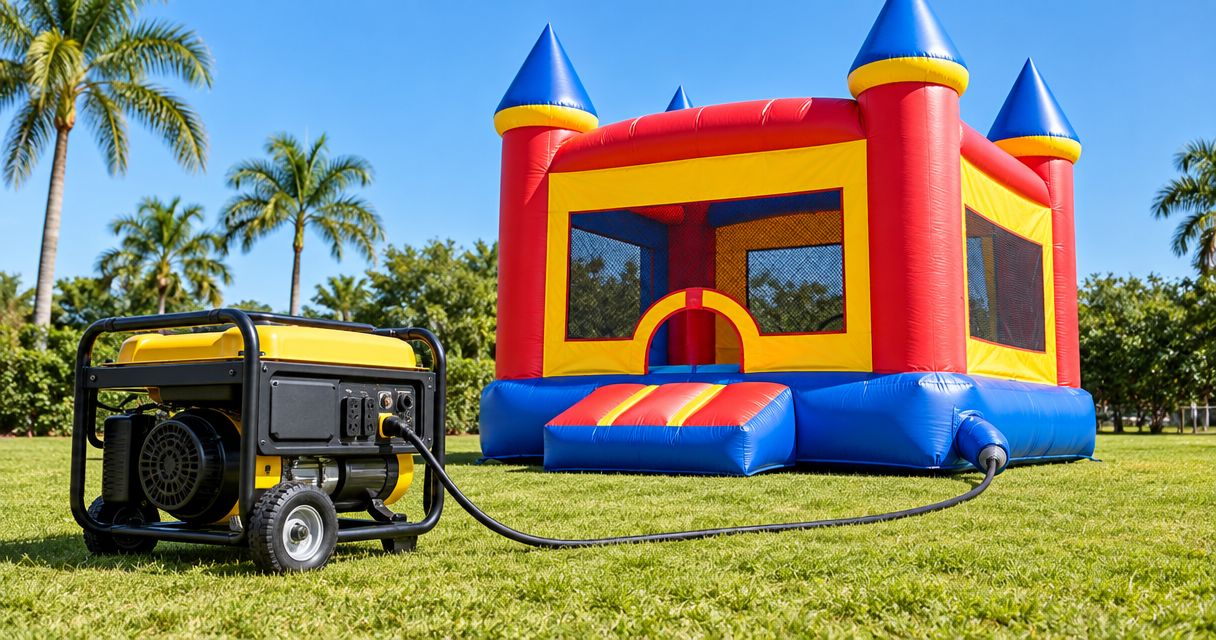
- Mark an acceptable generator location. For 2026 planning, follow U.S. Consumer Product Safety Commission portable-generator guidance: operate outdoors, at least 20 feet from buildings, with exhaust directed away from buildings and their openings. Never operate a generator in a garage, even with the door open.
- Check the route between them. Ask the provider to approve cord type, gauge, length, connections, and protection from traffic or water. If the route does not work, revise the layout rather than adding unapproved extensions.
- Assign the operating handoff. Identify who checks the equipment before use, monitors the power source, and responds to a shutdown. Keep guests away from generator equipment and follow the rental provider’s operating instructions.
Expected result: Your site sketch shows an acceptable power-source location, an approved connection route, and clear responsibility for operation.
The layout sequence is Equipment requirements, Power source, Site layout, and Operating handoff. Settle those decisions in that order so a convenient-looking generator spot does not dictate an unsuitable electrical arrangement.
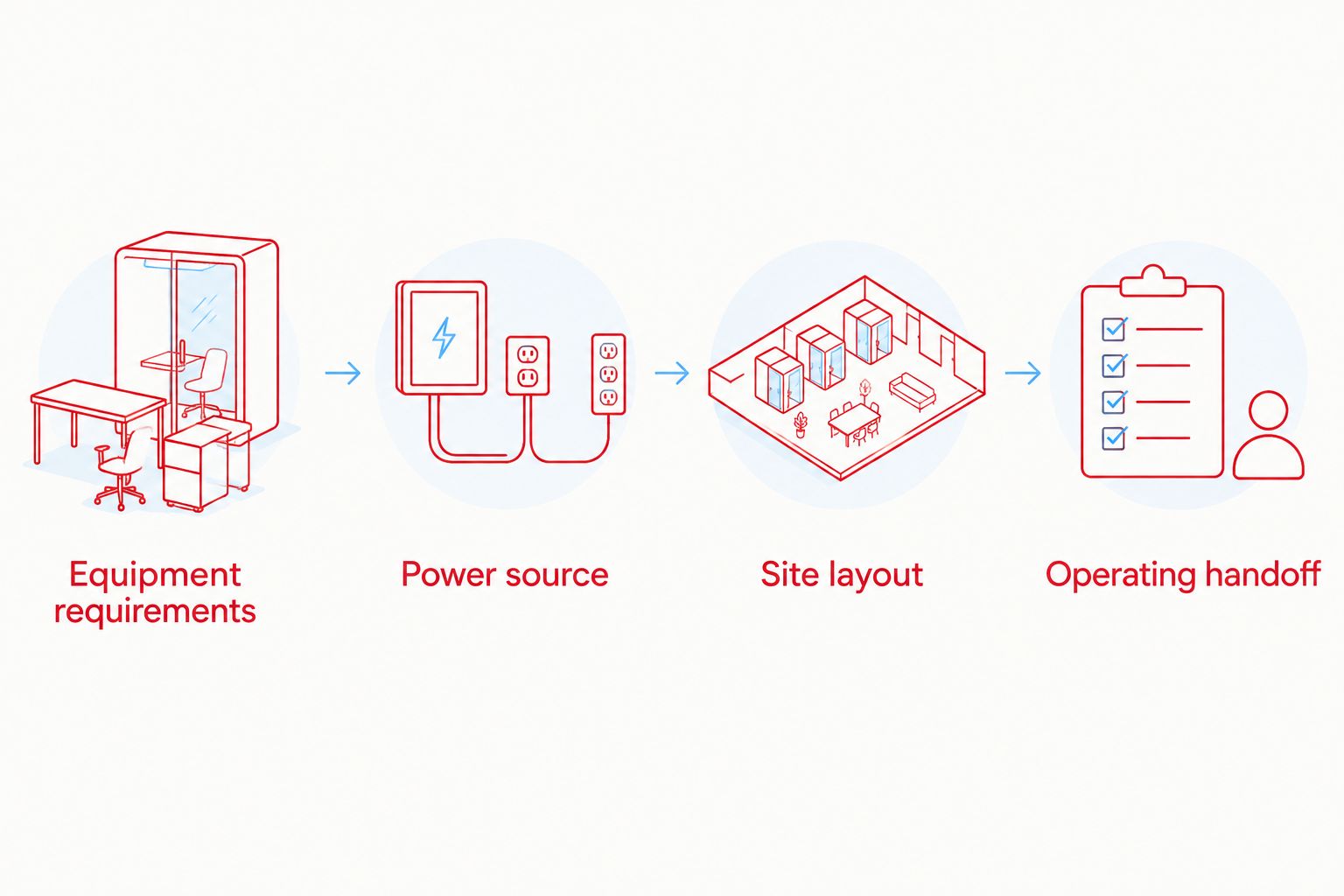
A backyard gate, school fence, or building entrance can change the practical cord route. Measure the route the cord will actually follow, not a straight line across areas guests need to use.
For water-based equipment, also plan the relationship between electrical connections, hoses, and drainage. The Phoenix water slide water and power access guide covers that adjacent planning task.
Variant: revise power whenever the equipment list changes
Adding a concession machine to a family birthday and adding another inflatable to a school carnival both require a power-plan review. Do not treat unused generator receptacles as permission to connect more equipment.
- Update the equipment list. Add the new item’s actual electrical requirements and intended operating schedule.
- Return the list to the power provider. Ask whether the existing source and individual connections remain suitable, including startup demand.
- Revise the site sketch. Check whether the new equipment introduces another cord route, queue, water source, or access restriction.
- Reissue the operating instructions. Tell the responsible adults which equipment connects where and who can authorize changes.
Expected result: Every addition has an approved power source and location before delivery day.
For a corporate or community event, give concessions and entertainment vendors the same current equipment schedule. For a backyard party, keep unrelated household equipment off the confirmed rental supply unless the responsible provider approves it.
Troubleshooting
The generator runs, but the blower will not start
Stop repeated starting attempts and keep the inflatable closed to guests. Have the responsible provider check startup capability, the selected outlet, protective devices, cord suitability, and the blower itself. A running engine does not prove usable power is reaching the equipment.
A breaker or ground-fault device trips
Stop use and notify the responsible operator. Do not bypass protection or repeatedly reset it without resolving the cause; overloads, damaged equipment, moisture, and connection faults require different fixes. A qualified person should determine the cause before operation resumes.
The blower sounds different or the inflatable loses firmness
Stop admissions and follow the rental provider’s procedure for clearing the inflatable. Ask the operator to check the power supply, connections, blower, and inflation system. Do not assume a larger generator will solve a mechanical or setup problem.
The generator location conflicts with guests or building openings
Revise the layout before operation. Do not move the generator closer to a doorway just to shorten the cord, and do not improvise an enclosure for weather protection. If no acceptable arrangement exists, resolve the site or equipment plan with the providers before proceeding.
Customize your workflow
For a 2026 backyard birthday, keep the handoff simple: one current equipment sheet, one site sketch, and a responsible adult who knows whom to contact. Confirm that the chosen setup leaves room for guests, tables, and the delivery route—not just the inflatable.
For a school, corporate, or community event, add a shared power map. Label each equipment area, its assigned supply, the responsible vendor, and the contact authorized to approve changes. Include the venue’s generator and fuel rules in the same document.
Ask Arizona Bounce Around about equipment selection, delivery and setup arrangements, and planning support for the event you describe. Request confirmation of responsibilities in the quote rather than treating general service descriptions as a promise about your specific event.
Your 2026 quote request should include:
- Event address, date, and operating hours.
- Requested rental equipment and expected audience.
- Photos or a sketch of the setup area and delivery access.
- Known electrical access and venue restrictions.
- Other vendors or equipment needing power.
- Questions about who supplies, connects, and operates the power equipment.
Plan your rental equipment
Share your event location, equipment list, and power questions when requesting a quote.
FAQ
What size generator do I need for bounce house generator power?
Choose the generator from the assigned blower’s running load, startup requirements, and connection specifications. Give those details and every additional electrical load to the generator provider before selecting equipment.
Can I use a regular outlet instead of a generator?
Yes, if the venue or a qualified electrician confirms that the circuit and connection meet the rental equipment’s requirements. An outlet’s location or appearance does not establish its suitability.
Does a bounce house blower stay on during use?
A continuous-air inflatable requires its blower to operate throughout use. Follow the instructions for the assigned rental, and never switch off its blower while guests are using it.
Can concessions share the bounce house generator?
Only connect concessions after the responsible provider approves the combined loads and individual connections. An unused receptacle does not establish that sufficient capacity remains.
How far should a portable generator be from a house?
The U.S. Consumer Product Safety Commission advises operating portable generators outdoors, at least 20 feet from buildings, with exhaust directed away from buildings and their openings. Follow generator instructions and venue requirements as well.
Can I refuel the generator while the bounce house is running?
Never refuel a running or hot generator; shut it down and let it cool according to its instructions. Coordinate any interruption with the rental operator so the inflatable is cleared and closed before its power supply stops.
What should I send Arizona Bounce Around before a 2026 event?
Send Arizona Bounce Around your event address, schedule, requested equipment, site photos, and known electrical access. Ask for confirmation of power requirements, delivery and setup arrangements, and who supplies and operates any generator.
One last thing
Treat every last-minute electrical addition as a change request. A speaker, fan, or concession machine belongs on the equipment sheet before someone plugs it in. The most useful event-day document is the final approved power plan—not the generator’s largest printed number.