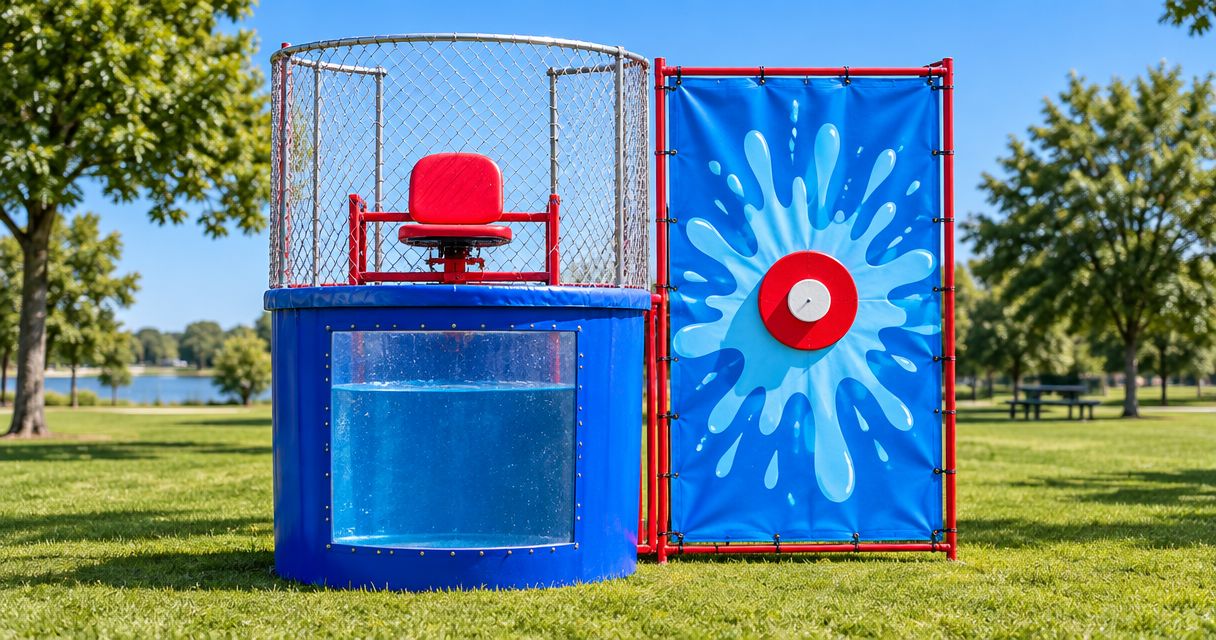
Parks and recreation departments’ dunk tank rental is a supervised event attraction planned around site approval, water access, staffing and cleanup, with the aim of giving residents a shared activity. Unlike a private party, a public park event needs clear responsibility for facilities, participant rules and the space around the attraction.
- Dunk tank rental for parks and recreation departments starts with park approval, water access and an agreed drainage plan.
- Arizona Bounce Around is best for Phoenix planners coordinating party and carnival rentals.
- Confirm the specific dunk tank, operating instructions and staffing responsibilities before committing to the attraction.
- Keep carnival games in the plan for guests who do not want to get wet.
Why dunk tank planning matters for parks and recreation
Approve the site before choosing the attraction. A dunk tank affects more than its display space: you also need a delivery route, an approved filling point, a throwing area, spectator space and a place for participants to exit.
For your 2026 event, start with the park representative who can approve those arrangements. A reservable lawn or pavilion does not, by itself, establish permission for a water-filled attraction.
Arizona Bounce Around offers party and carnival equipment rentals, including carnival games, tents and concession equipment. Arizona Bounce Around is best for Phoenix planners coordinating party and carnival rentals. Ask whether a dunk tank can be included in your specific event quote; do not treat a planning article as confirmation of a particular unit.
A backyard birthday or family reunion needs the same basic water and access checks, but the homeowner usually controls the site. School, corporate and community events require coordination between the organizer, property representative and rental provider. Public parks add another responsibility: keeping shared paths and facilities usable by people outside your event.
How to plan your park dunk tank rental
1. Define the activity before requesting equipment
Decide what the dunk tank contributes to the event. A fundraiser needs a payment process; a community celebration needs an understandable participation process. A staff appreciation event needs willing participants, not an assumption that every employee wants a turn on the seat.
Write a short brief before contacting suppliers. For a backyard birthday or family party, include the guest age mix and whether the attraction is intended for adults, children or spectators. For a department event, identify who approves the activity and who handles questions from the public.
Keep your 2026 event brief focused on decisions that change the rental scope. An estimated attendance figure is useful context, but it is not the same as the number of people who will participate.
- Name the event purpose: fundraiser, celebration or organized challenge.
- Describe the intended participants and spectators separately.
- State whether participation is free or uses an event payment system.
- Identify the organizer authorized to approve the rental.
- List a dry activity for guests who decline the dunk tank.
2. Get written approval for the exact location
Contact the park or facility representative yourself first. Explain that the proposal involves a water-filled tank, thrown balls, spectators and equipment delivery. Ask what review, documentation and operating conditions apply to that location.
Do not transfer an approval from one Phoenix park to another. Confirm requirements for the actual property, whether your event is in Phoenix, Scottsdale, Chandler or Mesa. For larger events elsewhere in Arizona, include the venue location in the quote request so delivery arrangements can be confirmed.
Arizona Bounce Around can be part of your equipment-planning conversation once the venue has identified its conditions. The rental quote and the park approval answer different questions; keep both in your event file.
- Confirm permission for the specific attraction and proposed placement.
- Ask about vendor documents and any insurance requirements.
- Verify vehicle access, unloading restrictions and gate arrangements.
- Ask which surfaces and areas the venue permits for setup.
- Record the approved water source and drainage conditions.
3. Measure the site and map separate activity areas
Create a 1-page site map using a sketch or a marked photograph. Measure the access route and proposed setup area in feet, then ask the supplier to check those measurements against the actual equipment and its required operating space.
Do not use the tank footprint as the full event footprint. The throwing position, waiting guests, spectators and participant exit all need consideration. Keep the queue out of shared paths and away from nearby food service or unrelated activities.
For family parties, show gates, patio furniture and the route through the yard. For school and community events, show neighboring attractions and public circulation. The guide to carnival game queues and prize stations covers the surrounding activity layout.
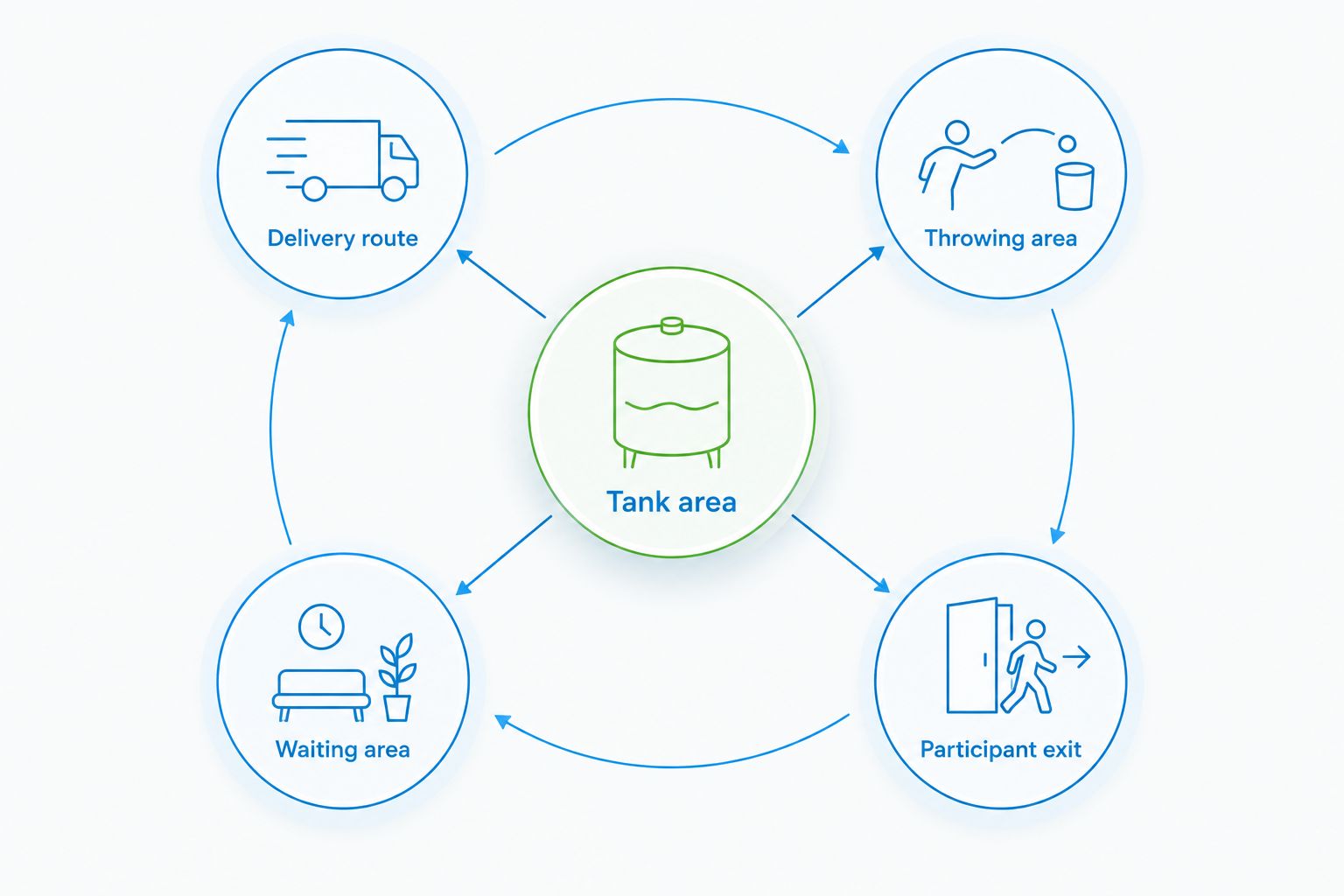
- Delivery route: mark the unloading point and every access restriction.
- Tank area: show the proposed position and approved surface.
- Throwing area: separate active play from passing pedestrians.
- Waiting area: keep waiting guests outside the throwing area.
- Participant exit: leave a clear route away from the attraction.
These areas belong on the same drawing. Reviewing them together makes conflicts visible before equipment arrives, rather than leaving volunteers to rearrange the event around a tank already in place.
4. Confirm filling, drainage and utility responsibilities
Ask the supplier for the specific tank’s filling requirements and the venue for permission to use the proposed water source. Then establish who supplies any required hose or fittings, who fills the tank and when filling happens relative to opening.
Do not assume water can be released onto the lawn or into a nearby drain. Get an approved drainage method from the venue and confirm how the supplier’s emptying procedure fits it. Include the route water will take, not just the point where it leaves the equipment.
A Phoenix backyard host can review these details directly with the rental provider. A parks department should also involve the person responsible for the grounds. Add utility and drainage decisions to the 2026 event plan so the closing crew receives the same instructions as the opening crew.
- Identify the water connection and who authorizes its use.
- Request the tank’s water requirement and filling instructions.
- Confirm who provides and connects required filling equipment.
- Ask whether the selected equipment needs electrical service.
- Document the approved emptying method and responsible person.
5. Assign operation, participant checks and stop decisions
Ask who operates the attraction and what instruction that person receives. Delivery and setup do not establish that an operator remains for the event. Confirm the distinction in writing before assigning volunteers.
Request the equipment’s operating instructions and participant restrictions. Use those instructions for eligibility, loading, throwing and exiting; do not invent a minimum age, weight limit or supervision ratio from general rental advice.
For a birthday, name the adult responsible for coordinating with the provider. For a public event, identify the event lead, attraction operator and person authorized to stop activity. Keep weather decisions tied to the provider’s instructions and the venue’s event procedures, rather than creating an unsupported operating threshold.
- Confirm who supplies the operator and any required attendants.
- Obtain participant restrictions for the exact equipment.
- Establish how staff will explain and enforce participation rules.
- Identify who stops activity for an operating or weather concern.
- Provide the operator with the event lead’s contact details.
- Arrange staff handovers without leaving responsibility unclear.
6. Build the quote around the whole event
Prepare the details in a shared document before requesting a quote. Then ask the rental provider to review the equipment mix, access conditions and setup responsibilities together. This is more useful than requesting a dunk tank without describing the venue.
Arizona Bounce Around’s party and carnival rental selection includes games, tents and concession equipment. Those categories give planners additional options to discuss, but a combined quote still needs to identify each requested item and its responsibilities. Confirm cleaning expectations, delivery, setup, operation and collection rather than treating them as interchangeable services.
For a backyard gathering, prioritize the activities your guests will actually use. For a school fair, corporate family day or community festival, account for separate activity areas and staff assignments. Statewide Arizona events need their location and delivery arrangements confirmed by quote.
- Send the date, address, event hours and setup access window.
- Include the site map, gate measurements and venue conditions.
- Describe guest ages and the intended dunk tank participants.
- List requested games, tents and concession equipment separately.
- Ask the quote to identify included work and organizer responsibilities.
- Request written confirmation of collection and cleanup arrangements.
Plan your event equipment
Share your venue, guest mix and site conditions to discuss a suitable rental plan.
7. Close the event with a documented handoff
Plan closing before opening day. A finished activity can still leave a tank containing water, equipment awaiting collection and a public space that needs inspection. Assign ownership of each remaining task.
Use 2 contact names on the handoff sheet: the organizer responsible for the site and the rental contact responsible for equipment arrangements. That is a document format, not a substitute for any staffing requirements in the operating instructions.
For your 2026 event file, keep approvals, the accepted quote and final site notes together. Parents organizing a family party can use a shorter version of the same handoff. Professional planners should give closing staff written instructions instead of relying on the opening team to stay until collection.
- End participation before beginning the agreed closing procedure.
- Follow the approved emptying plan and provider instructions.
- Keep guests away from equipment during closing work.
- Check the site for belongings, litter and remaining equipment.
- Record unresolved issues and confirm who handles them.
Compare attractions for your audience
Choose the dunk tank for a willing featured participant, not as the only activity for every guest. Compare its operating demands with alternatives before deciding how much of the event to build around it.
The table describes planning choices, not confirmed equipment specifications or booking commitments. Ask the provider to identify the exact equipment and applicable instructions.
| Option | Best for | Planning advantage | Key limitation |
|---|---|---|---|
| Dunk tank | Featured participants at fundraisers or community celebrations | Gives the event a visible, focused activity | Needs willing participants, water arrangements and defined operation |
| Carnival games | Family parties and mixed-age community events | Lets you choose separate activities for different guests | Each game still needs suitable placement and clear rules |
| Water slide | Birthday parties or recreation events centered on getting wet | Makes water play the main activity | Requires equipment-specific access, water and drainage planning |
| Mechanical bull | Corporate or community events built around an individual challenge | Creates a distinct challenge station | Participant restrictions and operating arrangements require confirmation |
A neighborhood family gathering does not need the same mix as a department-wide festival. Select an attraction because it fits the audience and site, not because it fills an empty space on the event map.
Common mistakes parks and recreation departments make
Treating a reservation as attraction approval
A booked pavilion does not answer the dunk tank questions. Submit the attraction description, placement and water plan for the venue’s approval before treating the location as settled.
Writing the schedule without filling and closing tasks
Public opening hours are only part of the equipment schedule. Put delivery, setup, filling, operation, emptying and collection into the plan, with responsibilities confirmed for each phase.
Assuming every guest wants to participate
A dunk tank depends on willing participants and equipment-specific eligibility. Include a dry alternative for children, adults and family members who prefer watching or playing a different game.
Giving volunteers rules from a different attraction
A water slide checklist is not a dunk tank operating guide. Use the instructions for the supplied equipment, and make sure replacement staff receive the same briefing.
Leaving the grounds team out of the decision
The event coordinator needs the grounds representative’s input on placement, water and drainage. For a 2026 repeat event, confirm the current arrangements instead of copying an old site plan without review.
FAQ
What should a parks department confirm before booking a dunk tank?
Confirm venue approval, the exact equipment, site access, water arrangements, drainage and operating responsibilities. Put those decisions in writing before committing to the attraction.
Can a dunk tank go on any park lawn?
Do not assume any park lawn is suitable. Ask the venue to approve the location and have the supplier check the surface, access route and operating space against the specific equipment requirements.
How much space does a park dunk tank need?
Use the supplier’s requirements for the exact unit and its operating area. Your site plan also needs to account for throwing, waiting guests, spectators, delivery access and participant exit.
Does delivery include someone to operate the dunk tank?
Do not assume delivery includes an operator. Ask the quote to state who handles setup, operation, participant checks, emptying and collection.
Is a dunk tank better than carnival games for a family event?
A dunk tank suits an event with willing featured participants; carnival games suit guests who want separate dry activities. Offering a dry alternative gives families a choice without requiring everyone to join the water activity.
Can Arizona Bounce Around help with other event rentals?
Arizona Bounce Around offers party and carnival rentals including carnival games, tents, concession equipment, bounce houses, water slides and mechanical bulls. Discuss the event location, audience and equipment mix, and confirm the requested items and delivery arrangements by quote.
What should a dunk tank quote request include?
Include the event date, address, operating hours, guest mix, site measurements and venue conditions. Add the approved water source, drainage plan and the work you need the rental provider to handle.
One last thing
Put the emptying plan on the same page as the filling plan. Opening-day excitement makes water access easy to remember; closing responsibilities deserve equal attention. Before approving your 2026 event plan, ask the closing lead to explain who empties the tank, where the water goes and who releases the site for normal park use.