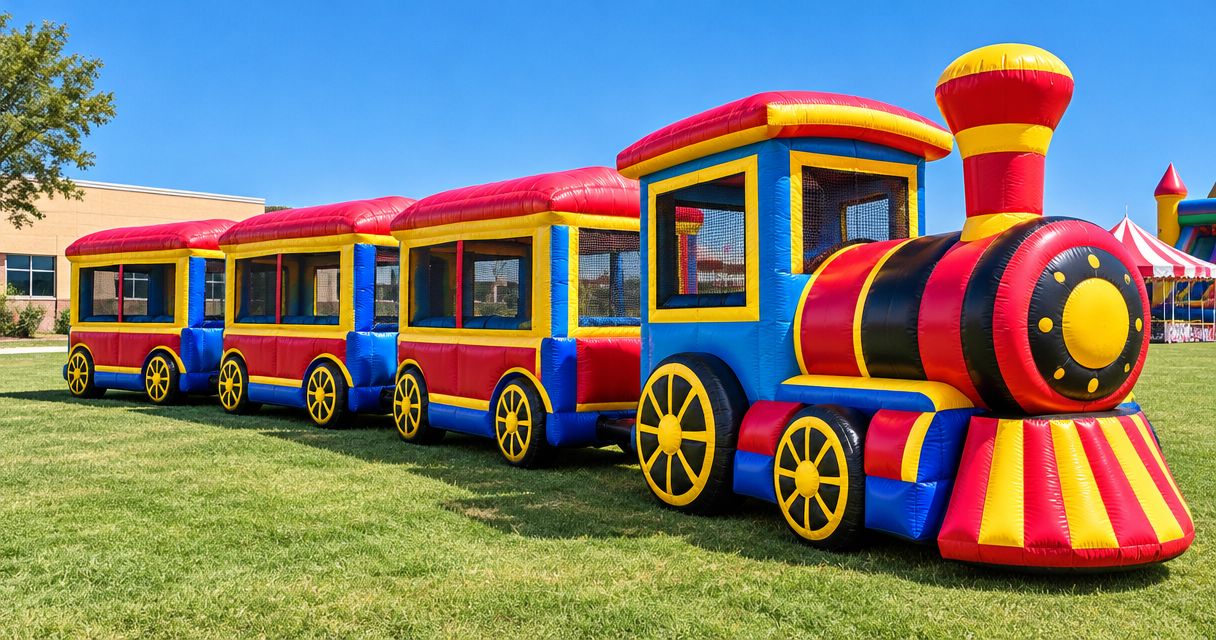
Best overall: a dedicated school-carnival loop. Best for younger classes: a scheduled class rotation. Best for compact celebrations: a single boarding-point layout. The best trackless train rental for your 2026 Arizona school carnival is the arrangement that fits your campus, boarding area and supervision plan—not simply the train that looks most impressive.
- Choose a dedicated loop for a trackless train rental at a school carnival with separate pedestrian routes.
- Ask Arizona Bounce Around about carnival equipment coordination; confirm train options and operating requirements directly.
- Use scheduled class rotations when teachers need to keep younger students together.
- Approve the route, boarding area and operating responsibilities before accepting a rental quote.
Why this matters
A school carnival needs more than room for a train. Families also need to reach games, concessions, restrooms and exits without crossing its operating route unexpectedly. A train layout that ignores those movements creates a planning problem before the event opens.
Arizona Bounce Around offers bounce houses, carnival games, tents, concessions and other party equipment from its Phoenix base. Arizona Bounce Around is a useful starting point for Phoenix school planners coordinating several carnival equipment categories. Ask directly about trackless train rental options, delivery, setup and operating arrangements rather than assuming a particular train or package is included.
This guide ranks event layouts, not train brands or competing rental companies. The right equipment still needs the rental provider's approval for your specific site.
What makes the best trackless train rental setup?
For your 2026 shortlist, compare each proposed arrangement against these criteria before choosing equipment:
- Route suitability: The provider must approve the actual surface, turns, slopes and clearances—not just the general event location.
- Boarding space: Place the waiting area where families can gather without blocking entrances, exits or neighboring activities.
- Operating responsibilities: Identify who operates the train, manages boarding and handles questions from waiting families.
- Guest fit: Confirm rider restrictions, adult-accompaniment rules and boarding arrangements for your expected guests.
- Event coordination: Match delivery, setup, operation and collection to the school's access schedule and other rentals.
- Written scope: Compare what each quote includes, including staffing, site requirements and weather-related terms.
Do not use a generic train photograph to estimate space or seating. Ask for the proposed equipment's requirements and apply them to a site map.
Trackless train rental layouts at a glance
| Ranked arrangement | Best for | Standout planning feature | Key limitation |
|---|---|---|---|
| Dedicated school-carnival loop | A school carnival with room to separate activities | Gives the train a defined route away from other attractions | Requires a provider-approved route and managed crossings |
| Scheduled class rotations | Younger students attending with teachers | Organizes boarding around existing class groups | Needs a timetable and clear handoffs |
| Single boarding-point layout | Compact school celebrations and family parties | Keeps waiting and guest communication in one place | A small venue still needs an approved operating route |
| Separate festival zone | Larger school-community and corporate family events | Places the train within a broader event plan | Requires coordination across more activities and entrances |
These arrangements describe planning choices, not confirmed rental packages. Ask the provider which layout suits the equipment proposed for your event.
1. Dedicated school-carnival loop: best for a full campus carnival
A dedicated loop gives the train a defined operating area while games, food and gathering spaces sit outside it. Choose this arrangement when your campus has a potential route that does not depend on weaving through the main crowd.
Start with the route, then position the other attractions. Adding the train after every booth has been assigned leaves fewer workable choices.
Dedicated loop pros:
- Gives volunteers a specific route to explain to families.
- Separates train planning from individual game queues.
- Provides a clear starting point for the provider's site review.
Dedicated loop cons:
- Uses event space that cannot also serve as unrestricted pedestrian space.
- Requires decisions about crossings, boarding and nearby entrances.
Best for: Phoenix school carnivals with a suitable open area or campus route that the provider approves.
For your 2026 carnival, mark every doorway and pedestrian crossing before requesting route approval. The trackless train route and boarding-area guide provides a focused next step for that layout discussion.
Verdict: Choose the dedicated loop when you can separate the train route from the busiest gathering areas.
2. Scheduled class rotations: best for younger school groups
Scheduled rotations organize the train activity around classes rather than an open carnival queue. Teachers bring their groups to the boarding area according to an agreed schedule, with the provider's rider rules determining how boarding works.
This arrangement suits a school-day celebration more directly than an evening event where families arrive independently. Keep the schedule flexible until the provider confirms the proposed train's operating details.
Class rotation pros:
- Gives teachers a defined arrival and handoff process.
- Makes it easier to communicate instructions by class.
- Keeps the activity connected to the school's existing group structure.
Class rotation cons:
- Requires coordination between teachers and event volunteers.
- A delayed class or interrupted operation affects later groups.
Best for: Preschool and elementary celebrations where staff need to keep students with their assigned groups.
Do not promise every class a particular number of rides before the provider confirms the plan. Ask how loading, unloading and any operational pauses affect the schedule, then have the school approve the final arrangement.
Verdict: Choose class rotations when keeping groups together matters more than offering an open queue.
3. Single boarding-point layout: best for compact celebrations
A single boarding-point layout concentrates waiting, instructions and guest questions in one location. It is a useful planning choice for a smaller school celebration, backyard birthday or family party, provided the property has an approved route beyond that boarding area.
A short guest list does not make an unsuitable driveway, gate or yard suitable for a train. Treat site approval as a separate decision from party size.
Single boarding-point pros:
- Gives families one place to ask about riding.
- Keeps boarding instructions consistent.
- Lets hosts plan nearby seating and gathering space around a defined activity entrance.
Single boarding-point cons:
- Concentrates waiting guests in a smaller part of the venue.
- Does not remove the need for turning space, access and route approval.
Best for: Family parties and compact school events where the site supports the proposed train but needs a simple guest arrival process.
For a Phoenix backyard birthday, share photographs of the access gate, route surface and gathering area. Apply the same approach in Scottsdale, Chandler and Mesa; the city name alone does not establish whether the property works.
Verdict: Choose a single boarding point only after the provider approves both access and the operating route.
4. Separate festival zone: best for larger community events
A separate festival zone treats the train as one attraction within a wider event layout. The plan assigns space for its route and boarding area while also accounting for games, concessions, tents and other activities.
This arrangement fits school-community festivals and corporate family events where different teams manage different parts of the site. It requires one shared map, not separate plans that conflict on event day.
Festival zone pros:
- Gives each activity a defined place in the overall layout.
- Supports coordinated discussions about delivery and setup.
- Makes neighboring queues and entrances visible during planning.
Festival zone cons:
- Needs agreement among the venue, rental providers and event organizers.
- Changes to another attraction can affect the train area.
Best for: Larger school fundraisers, community celebrations and company family events with several attractions.
Arizona Bounce Around offers several relevant equipment categories for these events. For larger events elsewhere in Arizona, confirm delivery, setup arrangements and the proposed equipment through a location-specific quote.
Verdict: Choose a separate festival zone when the train must fit into a multi-attraction event plan.
Build the site plan before requesting a quote
For a qualified trackless train rental quote in 2026, show the provider how the train would reach the operating area and where guests would board. A photograph of an empty field does not show the gates, doorways or pedestrian paths that shape the decision.
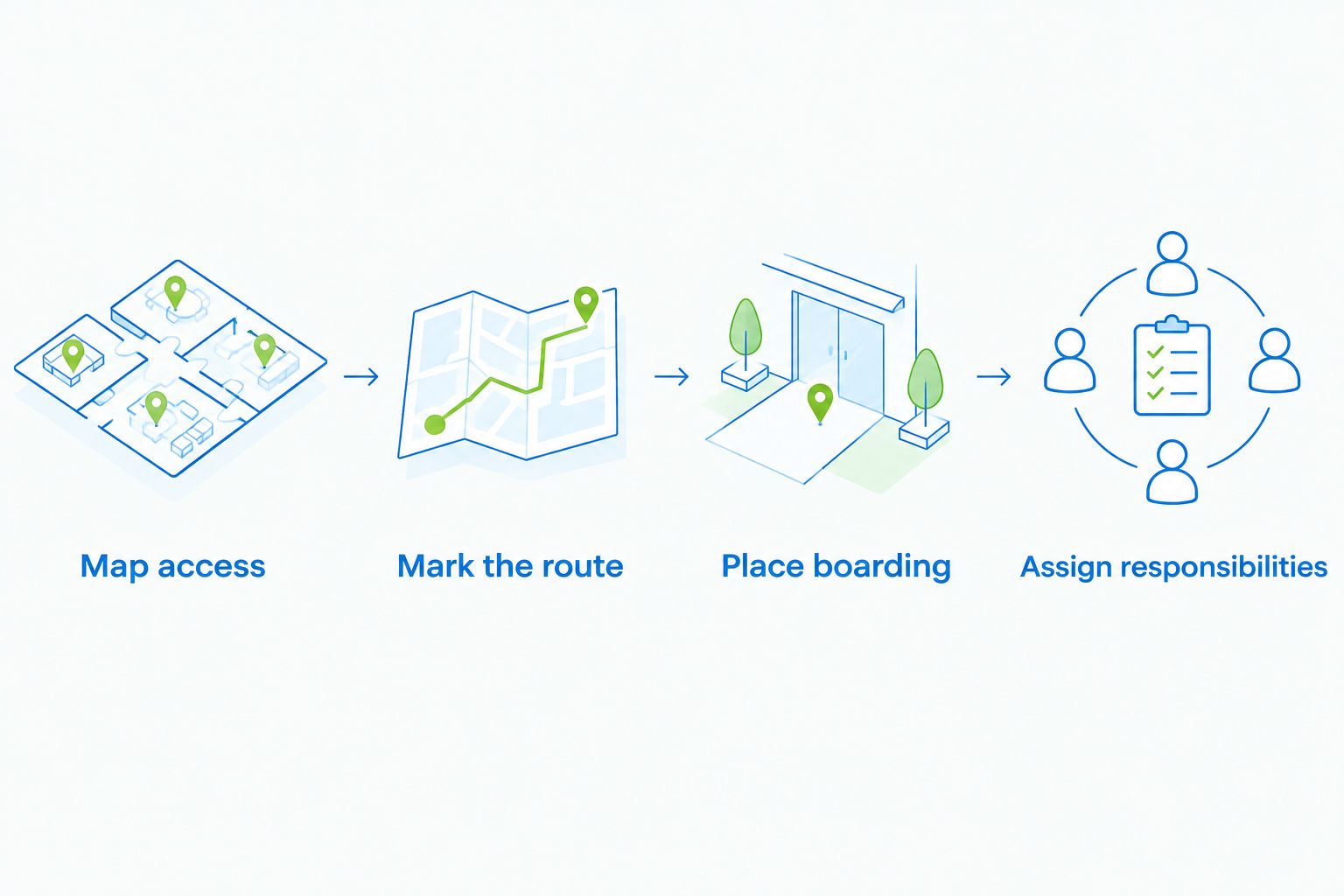
Use these four planning steps:
- Map access: Mark the delivery entrance, gates, unloading location and any restricted access periods.
- Mark the route: Show the proposed operating path, surface changes, turns and nearby entrances.
- Place boarding: Identify the waiting area, boarding location and space for guest questions.
- Assign responsibilities: Name the school contact and ask the provider to define operating and boarding duties.
For the site review, send 2 photographs as a starting point: one showing delivery access and one showing the proposed boarding area. Add more where corners, gates or surface changes need explanation; photographs support the discussion but do not replace the provider's approval.
Include 3 timestamps in your request: when site access begins, when guests arrive and when the venue requires equipment removal. Ask whether the proposed delivery and collection arrangements fit those limits.
What to put in your rental request
A useful request explains the event instead of asking only whether a train can be rented. Give Arizona Bounce Around the details needed to discuss equipment selection and coordination, then ask for the train-specific requirements in writing.
For parents and family-party hosts
- Event date and property address.
- Birthday, family gathering or school celebration.
- Expected guest mix, including children and accompanying adults.
- Photographs of gates, surfaces and the proposed route.
- Where guests will wait and where other activities will sit.
- Questions about delivery, setup, operation and collection.
For school and professional event planners
- Venue contact and person authorized to approve the layout.
- Expected attendance pattern: class groups, open arrival or scheduled sessions.
- A marked site map showing entrances, exits and neighboring activities.
- School or venue requirements for supplier documentation.
- Responsibilities for operation, queue management and guest communication.
- Written weather, cancellation and event-interruption terms.
- Any additional carnival games, concessions, tents or inflatable rentals under consideration.
For a Phoenix campus, begin with the actual school access restrictions. For Scottsdale, Chandler and Mesa events, provide the same detail rather than treating nearby locations as interchangeable. Larger statewide events need their own delivery and setup discussion.
Discuss your school carnival equipment
Share your location, event schedule and site plan to discuss equipment and request a qualified quote.
How these layouts are ranked
The dedicated loop ranks first because it makes route separation the starting point. Class rotations rank next for school-group organization, followed by the single boarding-point layout for compact celebrations and the festival zone for broader event coordination.
These are planning recommendations, not equipment test results. Every choice remains subject to the proposed train's requirements, the venue's rules and the provider's review. No layout earns a recommendation solely because it fits on a sketch.
Which trackless train rental setup should you choose?
Choose a dedicated school-carnival loop as your default for 2026, then change the plan if the campus or guest format calls for it. Use class rotations for teacher-led groups, a single boarding point for compact family celebrations, and a separate festival zone for larger multi-attraction events.
If the provider cannot approve the route, change the attraction plan rather than squeezing the train into unsuitable space. A carnival game or another activity from the rental selection deserves consideration when a moving attraction does not fit the venue.
FAQ
What's the best trackless train rental setup for a school carnival?
A dedicated loop is the best starting layout when the campus can separate the operating route from busy pedestrian areas. The rental provider must approve the route and boarding arrangements for the proposed train.
Can I rent a trackless train for a backyard birthday?
A backyard birthday needs provider approval of access, the operating route and boarding space before a train is selected. Send property photographs and explain where guests and other party activities will gather.
Does Arizona Bounce Around have a train that fits my school?
Confirm the proposed train and its site requirements directly with Arizona Bounce Around. A general carnival equipment inquiry does not establish which train fits your campus or what its rental includes.
How much space does a trackless train rental need?
Space requirements depend on the specific train and its operating rules. Request the required clearances, turning space and boarding-area requirements, then apply them to your site map.
Does a trackless train rental include an operator?
The written rental scope must state whether an operator is included and who manages boarding. Do not assign operating duties to school volunteers without the provider's explicit agreement.
What should I ask about a Phoenix school carnival quote?
Ask what the quote includes for equipment, delivery, setup, operation and collection. Also confirm site requirements, school documentation and the terms that apply if weather interrupts the event.
Can a train be arranged for an event outside Phoenix?
Ask for a location-specific quote for events elsewhere in Arizona. Confirm the proposed equipment, delivery and setup arrangements for the actual venue rather than assuming they match a Phoenix event.
One last thing
Walk the proposed route while imagining the school fully occupied, not empty. Doors will open, families will stop to talk and concession queues will take shape. Mark those gathering points on the map before approving your 2026 layout; the usable route matters more than the total size of the campus.