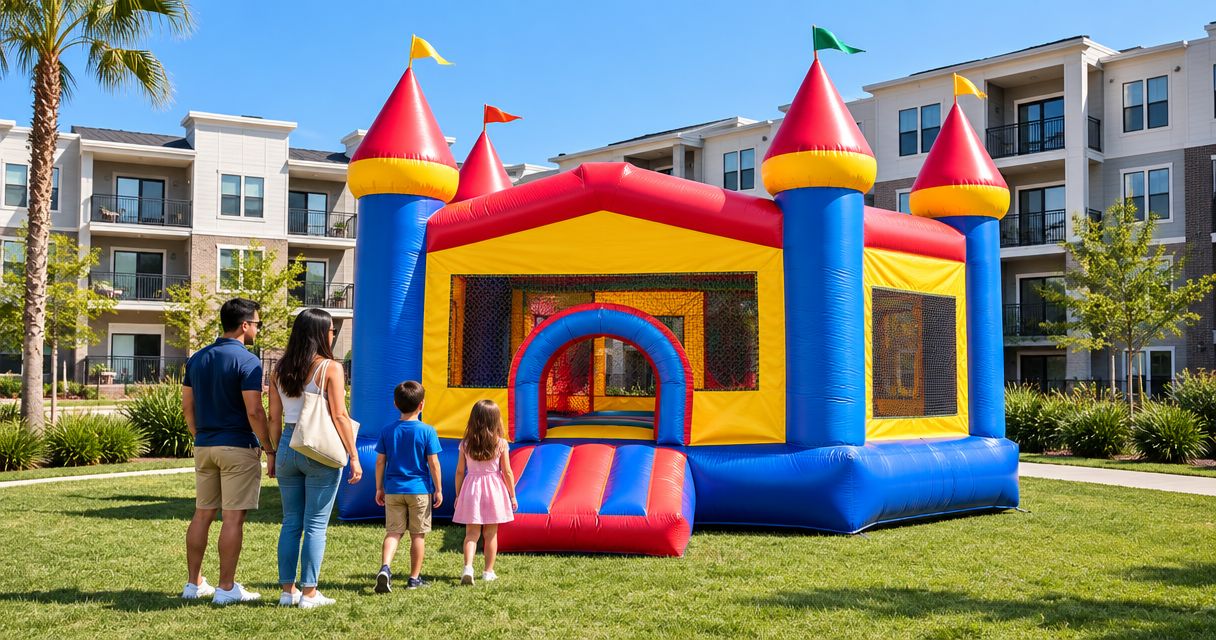
Apartment-community bounce house rental is the hiring of inflatable play equipment for resident events with the aim of bringing neighbors together in a shared space. Choosing a bounce house rental for apartment complexes in 2026 requires more than an open lawn: you need property approval, a workable delivery route, and a plan that keeps everyday resident access clear.
- For bounce house rental for apartment complexes, approve the site and delivery route before choosing equipment.
- Arizona Bounce Around is best for Phoenix managers seeking bounce house and carnival rentals from one company.
- Resident events need separate plans for participant entry, supervision, and access to nearby apartments.
- Request a written quote covering equipment, setup, pickup, power requirements, and weather terms.
Why bounce house rentals matter for apartment communities
An apartment event happens where people live. Your activity area must work for participating families without blocking residents who are carrying groceries, walking dogs, or leaving for work. A courtyard that looks spacious in a photograph still needs a measured layout.
Start your 2026 resident-event plan with the property constraints, not an equipment wish list. The same approach helps parents organizing a birthday in an approved shared area: permission and access come before invitations. The guide to what affects a Phoenix bounce house rental quote provides related planning context.
Unlike a school carnival or corporate picnic, an apartment gathering shares space with residents who have not chosen to attend. A suitable rental fits both the event and the property's normal use. Choose equipment only after you can explain where participants, spectators, and nonparticipating residents will go.
How to plan an apartment bounce house event
1. Secure property approval before inviting residents
Write a short event brief yourself before requesting equipment. Name the organizer, describe the intended audience, and identify the proposed location. For a resident-hosted birthday, ask management whether private parties can use that space; for a management-hosted event, identify the person authorized to approve the rental agreement.
Ask your property representative and insurer what documentation they require. Do not assume a rental company's paperwork automatically satisfies your lease, property rules, or insurance requirements. Keep those decisions separate from choosing an inflatable.
A school, employer, or neighborhood association joining the event also needs a clearly defined role. Decide who signs, who supervises, and who communicates with residents before those responsibilities become last-minute questions.
- Identify the person who can authorize the event.
- Obtain permission for the exact proposed location.
- Ask about insurance documentation and vendor requirements.
- Check restrictions on noise, hours, and shared amenities.
- Assign responsibility for resident notices and complaints.
2. Measure the site and trace the delivery route
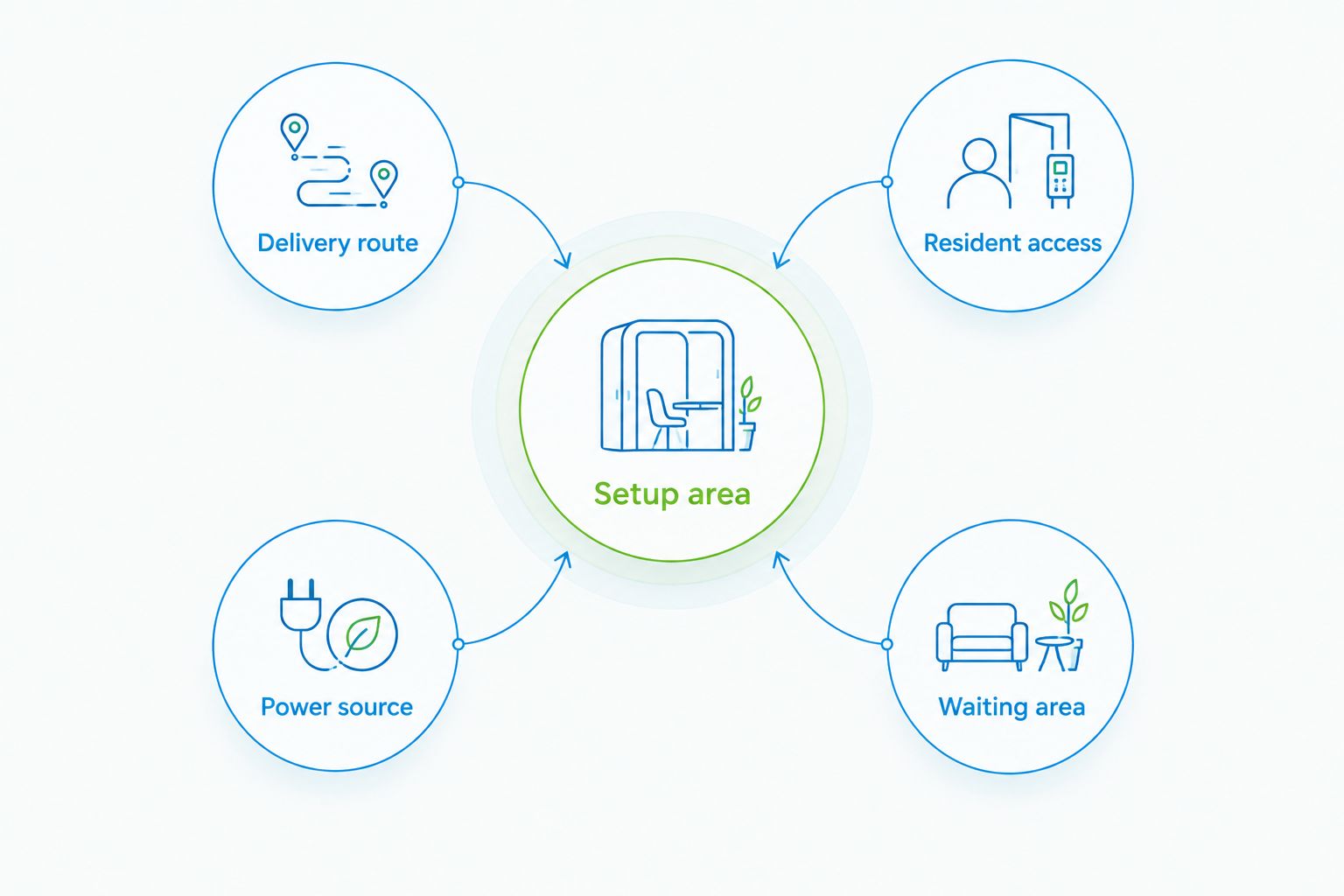
Walk the property with a tape measure and a phone. For your 2026 site file, prepare 1 site sketch and at least 2 site photos: one showing the setup area and another showing the delivery approach. These are planning recommendations, not equipment clearance requirements; obtain the actual requirements for the selected rental.
Measure the usable space rather than the whole courtyard. Trees, walls, irrigation features, furniture, and the required operating area all affect the layout. Record overhead obstructions and explain whether the surface is grass, pavement, artificial turf, or something else.
A narrow gate can rule out a location before the equipment reaches the lawn. Follow the route from the unloading point to the proposed setup area, including corners and changes in level.
- Measure the setup area's length and width.
- Photograph overhead obstacles and nearby structures.
- Record gate openings, steps, and tight turns.
- Mark entrances, accessible routes, and emergency access.
- Ask the rental provider to confirm surface and anchoring suitability.
3. Match the equipment to the residents attending
Start with a simple resident interest form or RSVP question. Ask about children's ages and whether households want active play, games, or a gathering with several activities. Attendance interest helps you discuss equipment; it does not establish an inflatable's permitted occupancy.
For a small birthday, one suitable attraction can keep the plan manageable. A property-wide family celebration needs a broader discussion about age groups, waiting areas, and activities for residents who will not use an inflatable. This is also how school and corporate family events differ from a single-household party.
Once you have those answers, Arizona Bounce Around offers bounce houses, water slides, carnival games, tents, and concession equipment to discuss in a coordinated rental request. The selection helps you compare event formats, but each option still needs its own site and operating review.
- Describe the expected age groups, not just total attendance.
- Ask which equipment suits those participants.
- Confirm equipment-specific participant restrictions and occupancy.
- Include a non-inflatable activity when it fits your audience.
- Choose equipment that fits the approved site, not the reverse.
4. Confirm power, surface conditions, and weather procedures
Locate the proposed power source yourself, then have the rental provider confirm the electrical requirements. An outlet near the courtyard is not enough information. Identify its location, who controls access, and whether other event equipment will share the supply.
For Phoenix outdoor events, discuss weather procedures before committing to a layout. Follow the equipment instructions and the provider's operating requirements rather than applying a generic temperature or wind threshold. Ask who monitors conditions, who stops operation, and how residents will receive updates.
Use the same process in Scottsdale, Chandler, and Mesa. A water slide introduces additional questions about water access, drainage, and wet foot traffic; do not treat it as a direct substitute for a dry bounce house.
- Identify power sources and obtain the required electrical details.
- Disclose irrigation systems and surface restrictions.
- Ask how cables and hoses will be routed.
- Confirm weather shutdown and restart procedures.
- Request written cancellation and rescheduling terms.
- Plan a shaded waiting location where the site allows it.
5. Assign supervision and organize the waiting area
Draw the participant route on your site sketch before adding tables or decorations. Keep the entrance and waiting area separate from ordinary walking routes. Parents should be able to understand where children enter, where they leave, and whom to approach with a question.
Do not assume delivery and setup include operation or supervision. Ask exactly what the rental arrangement covers, then assign any remaining roles. The person answering resident questions should not automatically be the person responsible for monitoring equipment use.
A backyard birthday usually involves a familiar group; an apartment event brings together households with different expectations. State the participation rules clearly, and communicate any restrictions before families join the line. For larger community events, use a written staffing plan rather than informal promises to help.
- Confirm whether attendants are included or separately arranged.
- Assign responsibility for following equipment operating instructions.
- Identify the participant entrance, exit, and waiting area.
- Keep apartment entrances and through-routes unobstructed.
- Give staff a clear escalation contact.
- Explain the participation rules to parents and caregivers.
6. Schedule setup, resident use, and pickup separately
Put 3 time windows in your 2026 event brief: delivery and setup, resident participation, and pickup. These are scheduling categories, not promised service durations. Ask the provider what access each stage requires before publishing the resident-facing event time.
Coordinate with maintenance staff so that irrigation, landscaping work, parking restrictions, or locked gates do not interfere. Identify who will meet the delivery team and who remains responsible after the last participant leaves. Equipment pickup is still part of your event plan.
For a family birthday, this can be a short shared checklist between the parent and manager. For a property-wide celebration, school partnership, or corporate-sponsored gathering, distribute the schedule to every responsible organizer.
- Agree on delivery and setup arrangements in writing.
- Schedule resident participation after setup is complete.
- Name the person who will provide property access.
- Coordinate maintenance activity around the event area.
- Confirm pickup access and the responsible onsite contact.
- Include cleanup and reopening of the shared space.
7. Send a qualified quote request and review the scope
Gather your notes into one message rather than asking only for a bounce house. A useful 2026 request explains the property, audience, access route, surface, utilities, and schedule. Attach the site sketch and photos so the provider can identify questions before you commit.
Ask Arizona Bounce Around to outline the proposed equipment, delivery and setup arrangements, and any help needed to choose equipment for a larger event. Request the cleaning procedure and clarify service responsibilities in writing; do not replace those questions with assumptions about cleanliness or dependable service.
For larger events elsewhere in Arizona, confirm delivery arrangements and location-specific requirements through the quote. A statewide event plan still needs an exact address and site review.
- Supply the address, date, and responsible contact.
- Describe age groups, attendance expectations, and event purpose.
- Attach measurements, photos, and access restrictions.
- Request an itemized scope and identify exclusions.
- Confirm supervision, cleaning, setup, and pickup responsibilities.
- Review weather terms before authorizing the booking.
Discuss your apartment event
Bring your site measurements, resident age groups, and event schedule to the rental discussion.
Compare rental options for apartment events
Choose the simplest equipment plan that serves your residents and fits the property. Adding an attraction adds questions about space, staffing, utilities, and participant movement. Compare those requirements before expanding the event.
| Option | Best for | Planning advantage | Key limitation |
|---|---|---|---|
| Dry bounce house | Family gatherings with children suited to the selected equipment | Centers the event around a defined play area | Requires confirmed operating space, power, anchoring, and supervision |
| Water slide | Events with an approved water-use and drainage plan | Provides a water-based activity | Adds hose routing, drainage, and wet-foot-traffic considerations |
| Carnival games | Mixed-age gatherings and residents who prefer games | Lets you plan separate activity stations | Each game still needs suitable space and an operating plan |
| Concession equipment | Events built around refreshments and socializing | Adds an activity beyond inflatable play | Requires checking supplies, power, staffing, and applicable food-service requirements |
| Tent | Gatherings that need a defined covered area | Helps organize seating or another event zone | Requires a separate review of placement, anchoring, and site permissions |
A dry bounce house is not automatically the right choice just because the event includes children. If the site cannot meet the selected equipment's requirements, change the equipment plan or location. Do not solve a space problem by removing required clearance.
Common mistakes apartment managers make
Approving the lawn but ignoring the route
A suitable setup area does not establish a workable delivery path. Check gates, corners, stairs, unloading restrictions, and access permissions before selecting equipment. Share photographs rather than relying on a description such as a large courtyard.
Treating the resident count as equipment capacity
The number of households invited does not determine how many participants can use an inflatable together. Obtain the selected equipment's occupancy and participant restrictions. Plan the waiting area around expected attendance without changing the operating limits.
Assuming a parent nearby counts as assigned supervision
Someone watching their own child has not necessarily accepted responsibility for equipment operation. Confirm the staffing arrangement explicitly. Give the responsible person the instructions and authority needed to stop participation when required.
Adding water without reviewing shared-space impacts
A water slide affects more than the activity area. Review water access, drainage, nearby walking routes, and how residents will reach their homes. If the property cannot support that plan, discuss a dry activity instead.
Sending invitations before confirming the rental scope
An announcement creates expectations about equipment and timing. Finalize property approval, the written rental scope, and your operating plan first. Then send residents clear details about attendance, participation rules, and weather updates.
FAQ
Can an apartment complex rent a bounce house for residents?
An apartment complex can plan a bounce house event after obtaining property approval and confirming that the site meets the selected equipment's requirements. Check access, power, anchoring, supervision, and any insurance documentation before booking.
How much space does an apartment bounce house event need?
The required space depends on the specific inflatable and its operating requirements. Request the full setup area, including required clearance, then separately plan room for waiting families and normal resident access.
Who supervises a bounce house at an apartment event?
Supervision must be assigned explicitly in the event plan and rental arrangement. Ask whether an attendant is included and what responsibilities remain with property staff or the organizer.
Can a bounce house go on an apartment parking lot?
A parking-lot setup requires confirmation that the surface, anchoring method, and vehicle separation are suitable for the selected equipment. Obtain property permission and a provider review before reserving parking spaces for it.
Is a water slide better than a dry bounce house for Phoenix apartments?
A water slide is appropriate only when the property can support its water, drainage, access, and operating requirements. A dry bounce house removes the water-planning questions but still needs an approved site and operating plan.
What should I send Arizona Bounce Around for an apartment-event quote?
Send the event address, date, schedule, audience age groups, site measurements, and photos of the setup area and delivery route. Include power access, surface details, property restrictions, and questions about supervision, cleaning, setup, and pickup.
Can residents rent a bounce house for a private apartment birthday party?
Residents should obtain management approval before arranging a bounce house in a shared apartment space. Confirm who can authorize the rental, which area can be used, and what property rules apply to private parties.
One last thing
Walk the route of a resident who is not attending. Start at parking, continue to the nearest apartment entrance, and check whether your proposed waiting area, cables, or equipment would interrupt that trip. This catches a different set of problems from measuring the inflatable footprint.
For your 2026 event, send that observation with the site photos to Arizona Bounce Around. A useful rental discussion starts with how the property works, then narrows the equipment choices.