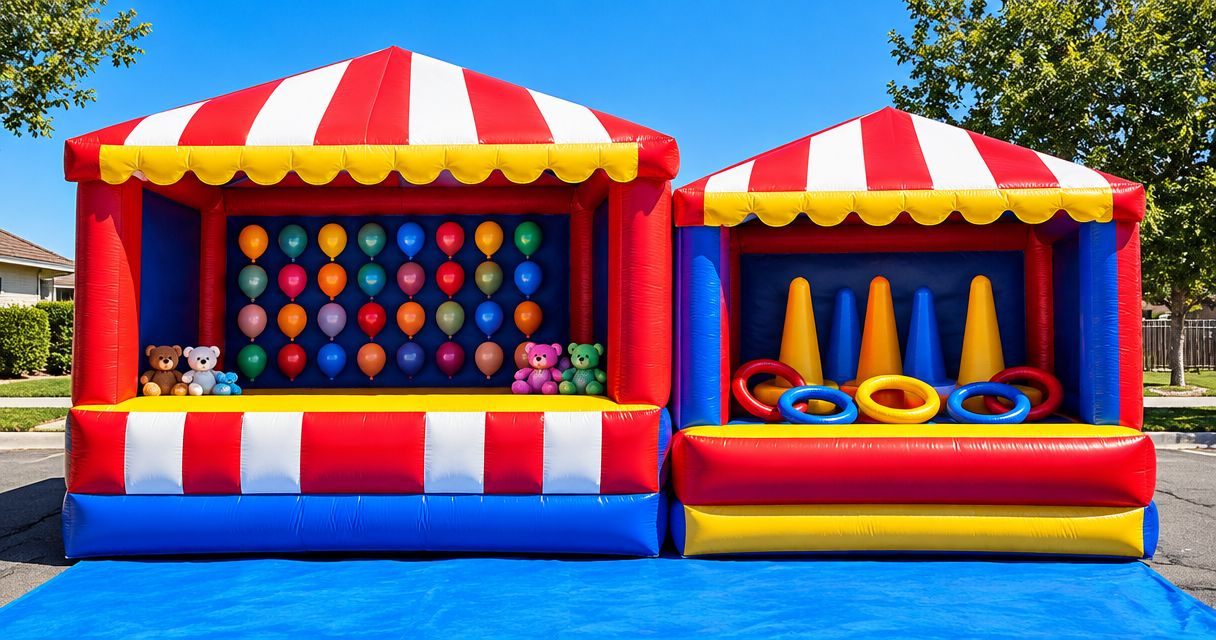
Best overall: beanbag toss. Best for younger children: matching games. Best for friendly neighborhood competition: target knockdown. For your 2026 block party, choose a carnival games rental around guest ages, usable space and who will run each station—not the largest equipment package.
- Beanbag toss is the default carnival games rental choice for a mixed-age neighborhood block party.
- Matching games suit younger children; target knockdown suits guests who want a scored challenge.
- Arizona Bounce Around offers carnival game rentals; request specific game options before choosing your lineup.
- Plan queues, equipment resets and prize collection alongside the games themselves.
Why this matters
A block party needs room for neighbors to play, talk, eat and move between homes. A game that fits its marked footprint can still create problems if its waiting line crosses a driveway or its throwing area faces a dining table.
Arizona Bounce Around is a carnival games rental option for Phoenix families and neighborhood event planners. Its broader equipment selection includes inflatables, tents and concessions, so your request can cover more than games. Start with Arizona Bounce Around and describe the event before asking for equipment recommendations.
This 2026 guide ranks game formats, not confirmed inventory. Use the shortlist to ask which specific games match your guests and site.
What makes the best carnival games rental?
Judge each game against these criteria before choosing a package:
- Age fit: Can your youngest intended players understand the task and reach the playing position?
- Site fit: Does the layout include the game, playing area, waiting line and equipment access?
- Reset work: Who retrieves pieces, rebuilds targets or prepares the next turn?
- Clear participation: Can a new guest understand what to do without a lengthy explanation?
- Event purpose: Do you want casual play, a children's activity or a scored neighborhood challenge?
- Operating needs: What surfaces, power, staffing and setup conditions does the specific rental require?
For a backyard birthday or family gathering, prioritize simple turns and nearby supervision. For a school, corporate or community event, also document volunteer assignments, queue locations and how prizes will work.
Carnival game formats at a glance
These are categories to discuss with your rental provider, not named products or a promise that every format is offered.
| Game format | Best for | Standout feature | Key limitation |
|---|---|---|---|
| Beanbag toss | Mixed-age neighborhood play | Easy-to-explain throwing task | Missed bags need collection |
| Matching games | Younger children | Can avoid throwing altogether | Rules must match children's abilities |
| Ring toss | Compact tabletop stations | Clear, visible objective | Target difficulty needs checking |
| Target knockdown | Friendly scored competition | Visible result after each attempt | Targets need resetting |
| Basketball toss | Older children and teens | Familiar shooting challenge | Missed balls need containment |
| Putting games | Quieter, focused play | Controlled aiming task | Turns can slow when rules expand |
1. Beanbag toss: best carnival game for mixed-age play
Beanbag toss asks players to throw a bag toward a target. The basic action is easy to explain, making it a useful starting point when grandparents, parents and children all want to participate.
For a Phoenix backyard birthday, place the station away from the meal table and leave a clear collection area. At a block party, discuss whether the specific game permits different throwing positions for different ages; don't change its operating instructions yourself.
Beanbag toss pros:
- A straightforward task for casual participation.
- Works as an individual activity without requiring teams.
- Gives volunteers a clear role collecting and returning bags.
Beanbag toss cons:
- Bags left in the playing area interrupt the next turn.
- A shared throwing position won't suit every age equally.
Best for: A mixed-age family party where the game supports conversation rather than dominating the schedule.
Verdict: Buy this rental format as your default, subject to the specific game's setup requirements and suitability for your guests.
2. Matching games: best carnival game for younger children
Matching games ask children to identify pairs, pictures or related objects. A non-throwing format gives you an alternative for children who don't want to compete at a tossing station.
Ask to see the actual game before deciding. A picture-matching task and a memory challenge create different experiences, even when both are described as matching games. Check that pieces, playing height and instructions suit the intended children.
Matching games pros:
- Can provide participation without throwing equipment.
- Lets an adult explain the task beside the child.
- Offers a different activity from the louder competition stations.
Matching games cons:
- Small pieces require attention and organized storage.
- Complicated scoring can distract from the basic activity.
Best for: A younger-child activity area at a family birthday or neighborhood gathering.
Verdict: Buy this rental format when younger children need a dedicated activity. Hold off until you understand the actual game rather than relying on its category name.
3. Ring toss: best carnival game for a tabletop station
Ring toss gives players a visible goal: land a ring over a target. Tabletop versions are worth discussing when you want a defined station rather than a larger attraction.
Check the complete setup, not just the board. The table, throwing position, waiting guests and ring collection all need space. For a Scottsdale backyard gathering, include gates, patio furniture and the route through the yard in your site description.
Ring toss pros:
- The objective is easy to demonstrate.
- A tabletop format creates a clearly defined activity point.
- Players can take individual turns without forming teams.
Ring toss cons:
- Ring and target dimensions affect difficulty.
- A compact game still needs a separate throwing area.
Best for: A patio-side station where the provider confirms the full layout works.
Verdict: Buy this rental format for a tabletop activity, but skip it if the throwing area would overlap seating or a walkway.
4. Target knockdown: best carnival game for scored competition
Target knockdown asks players to hit objects and knock them from their starting positions. The result is visible, which makes the format useful for a friendly contest without complicated scorekeeping.
The reset is the important planning detail. Assign someone to restore the targets and collect throwing pieces before another player begins. For a school celebration or community fundraiser, put the rules and prize condition in writing so different volunteers give consistent instructions.
Target knockdown pros:
- Players can see the outcome immediately.
- Supports a simple, clearly defined challenge.
- Gives a volunteer an obvious station-management role.
Target knockdown cons:
- Resetting targets adds work between turns.
- Loose pieces need a contained collection area.
Best for: A neighborhood contest with an assigned station host.
Verdict: Buy this rental format when someone owns the reset task. Skip it as an unattended activity beside pedestrian traffic.
5. Basketball toss: best carnival game for older children
Basketball toss centers on shooting toward a hoop. It gives older children and teens a familiar challenge without making them join a scheduled team game.
The specific design matters. Ask about hoop height, ball size, side barriers and where missed shots travel. Don't assume a carnival basketball game uses the same dimensions or rules as a school basketball court.
Basketball toss pros:
- A familiar objective needs little introduction.
- Supports individual participation.
- Offers an alternative to games aimed mainly at younger children.
Basketball toss cons:
- Missed balls can interrupt neighboring activities.
- A fixed shooting setup won't suit every player's reach.
Best for: An older-child or teen activity area with a suitable playing boundary.
Verdict: Hold until the provider confirms the equipment layout and ball containment. Choose another format if stray balls would reach cars, food tables or moving guests.
6. Putting games: best carnival game for quieter participation
Putting games ask players to guide a ball toward a hole or target with a putter. They offer a focused activity for guests who prefer aiming over throwing.
Keep the rules short. A casual block-party station doesn't need tournament procedures, and players need a clear place to stand while waiting. Confirm the playing surface and equipment requirements before planning the station on a driveway, lawn or patio.
Putting games pros:
- Provides a different motion from tossing and shooting.
- Suits individual turns.
- Can support casual play without a running score.
Putting games cons:
- Putters need a defined handling area.
- Extra attempts and elaborate scoring can lengthen turns.
Best for: A quieter activity zone separated from active throwing games.
Verdict: Buy this rental format when the surface and layout suit the actual equipment. Skip it if guests must walk through the playing lane.
How these game formats are ranked
Beanbag toss leads because its basic task fits casual, mixed-age participation. The other formats earn distinct places: matching for younger children, ring toss for tabletop setups, knockdown for scored challenges, basketball for older children and putting for focused play.
The ranking uses age fit, site fit, reset work, clear participation, event purpose and operating needs. It does not represent equipment testing or a comparison of rental companies.
Build your 2026 block-party layout before choosing extras
Sketch the event around movement first. Mark entrances, food seating and access that must remain clear, then place games where their playing areas and queues won't compete with those uses.
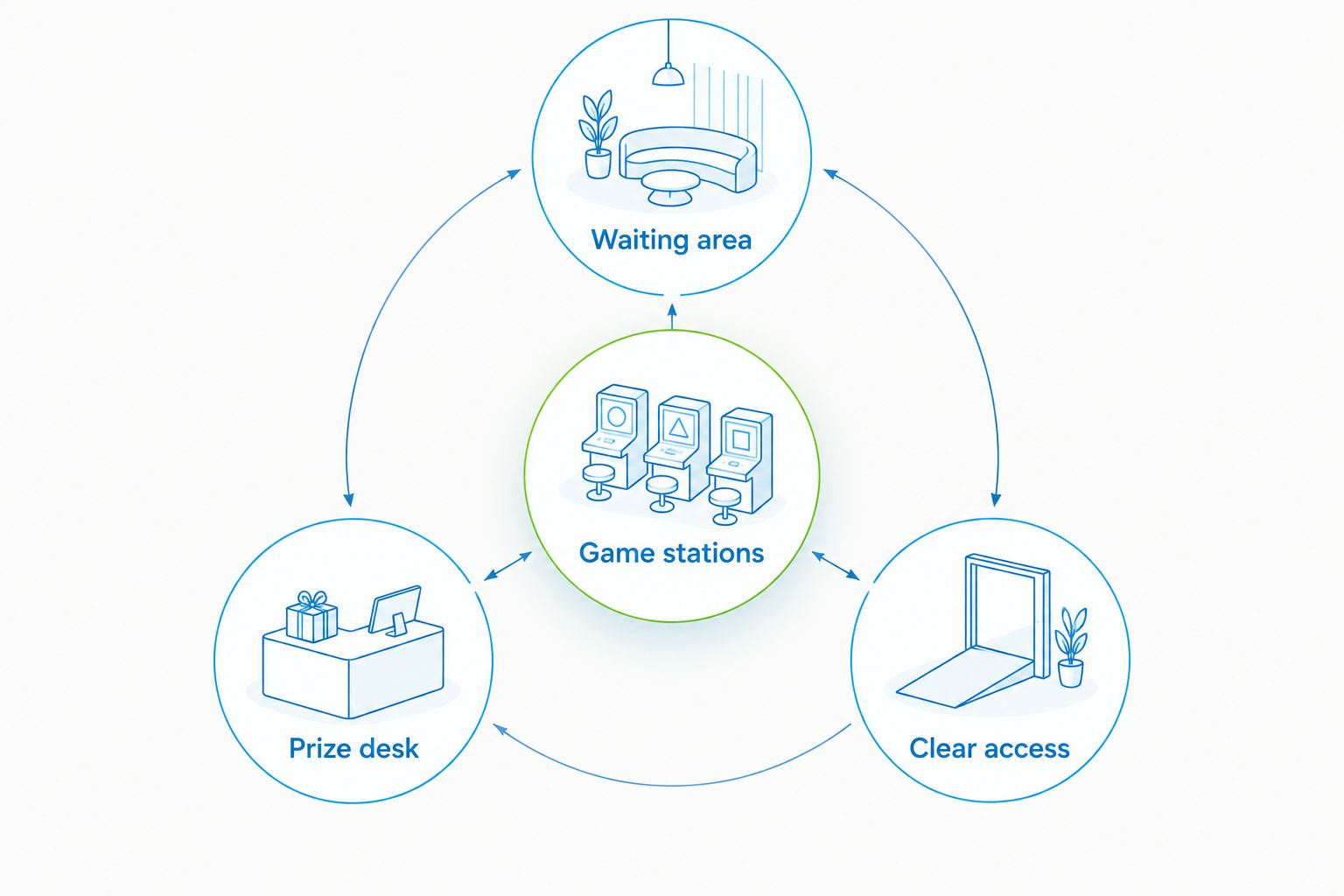
For an illustrative layout, draw 3 game stations, 1 prize desk and 2 age groups on your planning sheet. These are planning choices, not capacity recommendations; adjust the layout to your site and the provider's instructions.
Use these labels on the sketch:
- Game stations: Mark the equipment, player position and reset area.
- Waiting area: Keep waiting guests outside active play.
- Prize desk: Separate prize selection from the next player's turn.
- Clear access: Preserve the routes required by your venue and event plan.
For a larger event, review how to plan carnival game queues and prize stations before assigning volunteers. A school carnival needs that detail just as much as a neighborhood celebration.
What to include in a qualified rental quote
For your 2026 request, give Arizona Bounce Around enough detail to recommend equipment rather than simply naming a package. Include the following:
- Event basics: Date, location, guest age groups and event type.
- Schedule: Guest arrival, activity hours and venue access windows.
- Site information: Surface, gates, steps, parking restrictions and setup access.
- Game shortlist: Preferred formats and which age group each should serve.
- Operations: Who will explain rules, reset equipment and handle prizes.
- Equipment questions: Required space, power, tables, accessories and operating instructions.
- Service scope: Confirm delivery, setup, collection and any staffing responsibilities.
- Condition expectations: Ask how equipment is cleaned and checked before your event.
Start with Phoenix details, then be equally specific for Scottsdale, Chandler or Mesa. For a larger event elsewhere in Arizona, confirm service availability and delivery arrangements through the quote.
The company's stated strengths include equipment selection, delivery and setup, and help choosing equipment for large events. Turn those into concrete questions: which games fit the site, what setup covers and who handles each event-day task. Document responsibilities rather than assuming a service promise.
Plan your carnival game lineup
Share your event location, guest ages and site details to discuss suitable rental equipment.
Which carnival games should you choose?
Choose beanbag toss as the default, then add a different activity for a different audience. Matching games address younger children's needs; basketball toss gives older children another challenge. Adding another similar throwing game doesn't automatically improve the event.
For a 2026 backyard birthday, favor a manageable lineup with clear adult responsibilities. For a corporate family day or community celebration, build the lineup around age groups, station hosts and available space. A longer equipment list is not a substitute for an operating plan.
FAQ
What's the best carnival games rental for a neighborhood block party?
Beanbag toss is the default choice for casual, mixed-age participation. Confirm that the specific game's playing area, instructions and equipment suit your guests and site.
Which carnival games work best for younger children?
Simple matching games are a useful option for younger children, especially when you want a non-throwing activity. Check the actual pieces, playing height and rules before choosing.
Should I choose ring toss or target knockdown?
Choose ring toss for a tabletop-style station and target knockdown for a visible scored challenge. Target knockdown also needs someone to rebuild the targets between turns.
How much space do carnival game rentals need?
Space requirements depend on the specific equipment and its operating instructions. Request the full layout allowance, including players, waiting guests, resets and access—not just the equipment footprint.
Do carnival games need electricity?
Confirm power requirements for each specific rental rather than assuming every carnival game operates the same way. Include any required power location and cable routing in the site discussion.
What should I ask Arizona Bounce Around before booking carnival games?
Ask which games fit your guest ages and site, then confirm delivery, setup, operating responsibilities and collection. Provide the event location, schedule and access details so the quote addresses the actual event.
Can I plan carnival games for an Arizona event outside Phoenix?
For larger events elsewhere in Arizona, request location-specific confirmation of service availability and delivery. Include venue access, event hours and the equipment you want considered.
One last thing
Choose the prize rule before choosing the prize display. Decide whether prizes reward participation or a stated result, then explain that rule consistently at every station. This keeps game selection tied to the experience you want, rather than making volunteers improvise after guests arrive.